


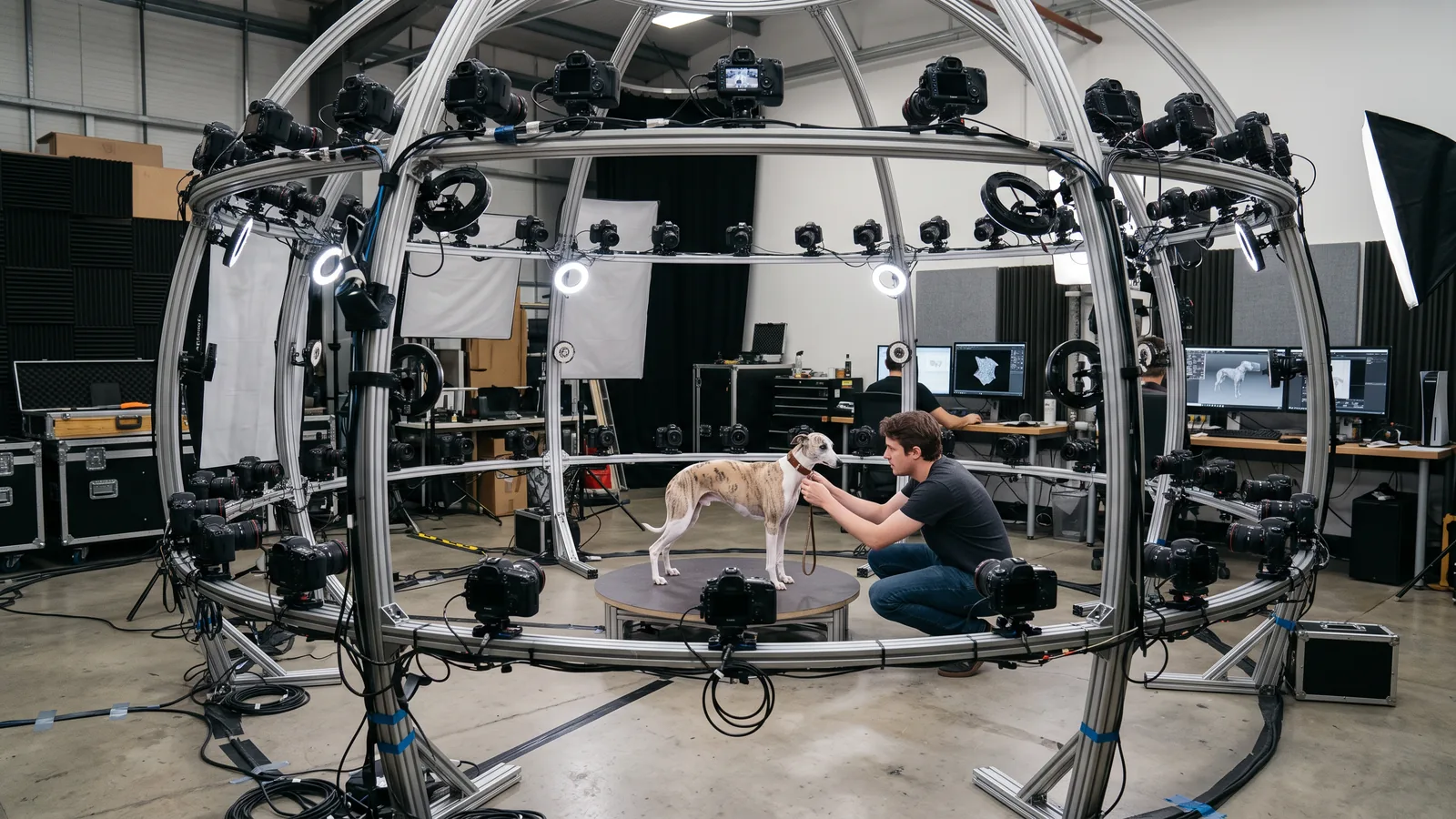
The Whippet is the most extreme-geometry dog in the sighthound family available as a photogrammetry scan. The breed’s physical characteristics — extremely lean musculature, prominent rib cage, deeply tucked abdomen, fine head and long neck — create a 3D reconstruction challenge that is unlike any other breed’s.
The Whippet’s coat is so thin that it is essentially non-existent as a photogrammetry variable. What the cameras see is not coat texture but actual body surface — the visible ribs, the musculature of the shoulder and thigh, the skin’s movement over the rib cage. This makes body geometry accuracy the primary challenge, rather than coat texture.
Geometric accuracy at the body surface
For most dog breeds, a small error in reconstructed surface geometry — a slight smoothing of the body surface, a minor inaccuracy in the chest shape — goes unnoticed because the coat texture masks it. For a Whippet, there is no such masking. The body surface is the coat.
The ribs are visible as surface ridges. The iliac crest at the hip is a prominent landmark. The musculature of the thigh and shoulder creates surface variation that is captured — or not — with no fur softening. Any reconstruction error in the surface geometry is immediately visible in the final model.
This requires:
Higher camera density at body areas. A standard dog scan rig is configured for fur-coated breeds. For the Whippet, the camera density at flank and body areas needs to be higher than standard to resolve the fine surface geometry of visible musculature.
Lighting that reveals surface structure. The studio lighting for a Whippet scan must be carefully designed to show surface curvature without creating specular highlights that obscure surface detail. A lighting setup with slightly more directionality than standard — to create subtle surface shading — will improve reconstruction quality in the musculature areas. Too much diffusion loses the surface structure that the reconstruction algorithm needs.
Tight calibration. The photogrammetry calibration accuracy determines the smallest surface feature that can be resolved. For a Whippet, the calibration must be tighter than for a typical fur-coated dog, because the surface features being captured are smaller and more critical to the final model’s accuracy.
The arched back and tucked abdomen
The Whippet’s characteristic silhouette — the arched topline, deeply tucked abdomen, and long neck — is what makes it immediately recognizable. It is also one of the more demanding geometric features to capture correctly in a scan.
The abdominal tuck creates an acute angle between the ribcage and the hindquarters. Camera views from the side need to fully resolve this angle, which requires camera positions at dog-height level. If the scan rig’s lowest cameras are too high, the extreme abdominal tuck will be partially occluded and reconstructed incorrectly.
The arched topline, with its characteristic curve from the shoulder to the croup, needs to be captured from directly above at sufficient resolution. Top-mounted cameras are essential.
Whippet behavior in the studio
The Whippet’s behavioral profile in a scan studio is shaped by two opposing tendencies: the breed is typically gentle, non-aggressive, and responsive to calm handler direction; but it is also a sighthound, which means its attention is drawn powerfully to any movement in the environment.
A camera rig with 60–100 black objects at various heights, none of which is moving, is tolerable for a Whippet. The same rig with any movement — a camera on a moving rail, a person adjusting equipment — will trigger the breed’s movement-attention reflex, causing the dog to track the motion with its head.
Keep the studio still during capture. All equipment adjustments must be completed before the dog is in position, and the scan captures must be taken in a fully static environment. If anything moves during a capture attempt, the head will follow it.
What a correctly scanned Whippet delivers
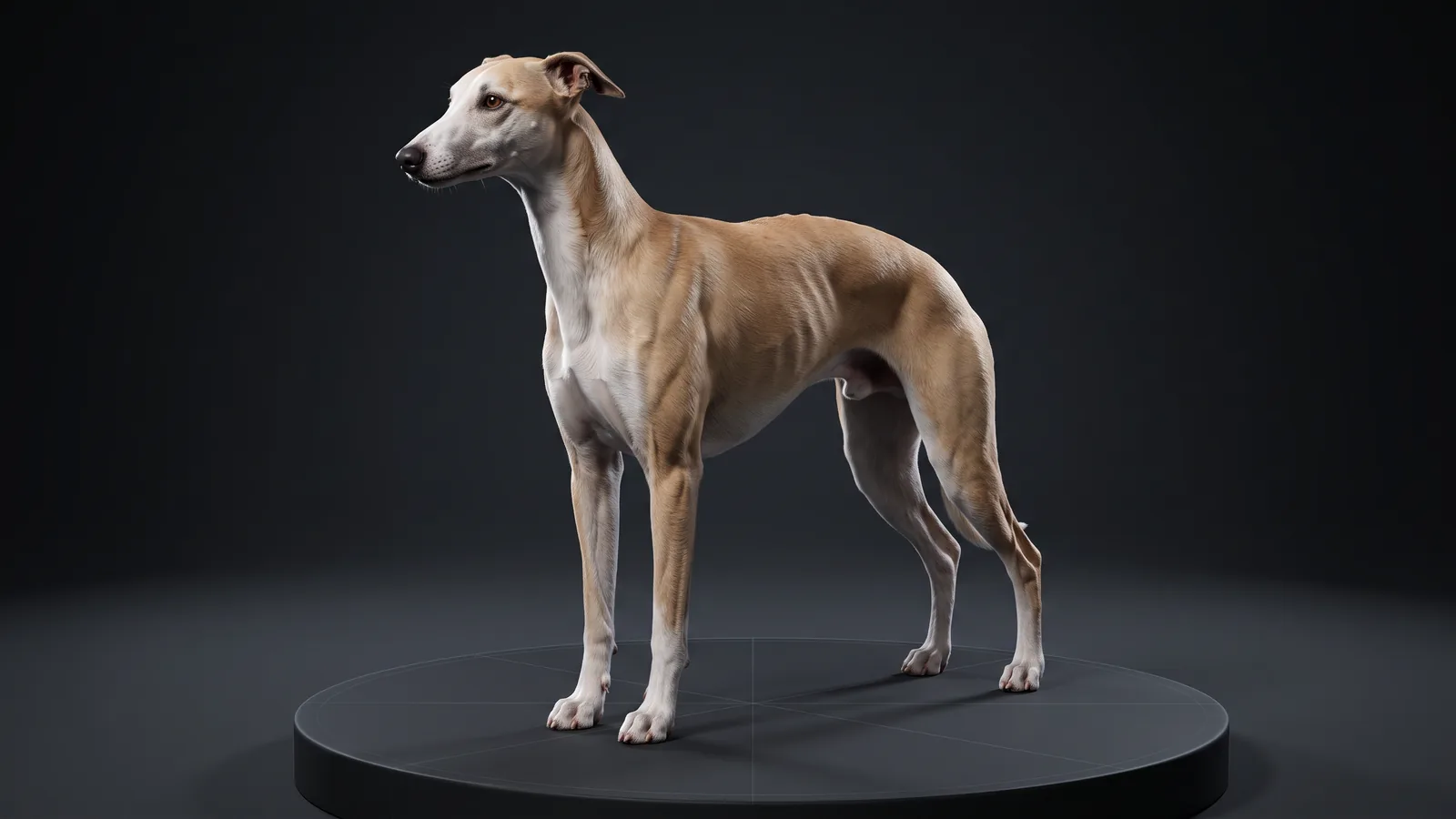
Visible musculature surface detail. The shoulder muscle mass, the thigh muscles, and the rib cage surface all show correctly in a properly captured Whippet model. This is detail that cannot be approximated from a generic dog base mesh.
Accurate silhouette proportions. The Whippet’s silhouette — arched back, tucked abdomen, fine head, long neck, deep chest — is the breed’s primary identifier at any distance. Getting this correct is the main value of a photogrammetry scan over a hand-modeled asset.
Thin coat skin texture. The near-hairless coat shows the skin’s own texture at microscopic scale — fine hair direction, subtle color variation — that contributes to the photorealistic quality of the render.
The Renderbot Whippet 3D model is scanned using a high-density camera configuration and calibration protocol optimized for thin-coat sighthound breeds.
Comments
No comments yet.