


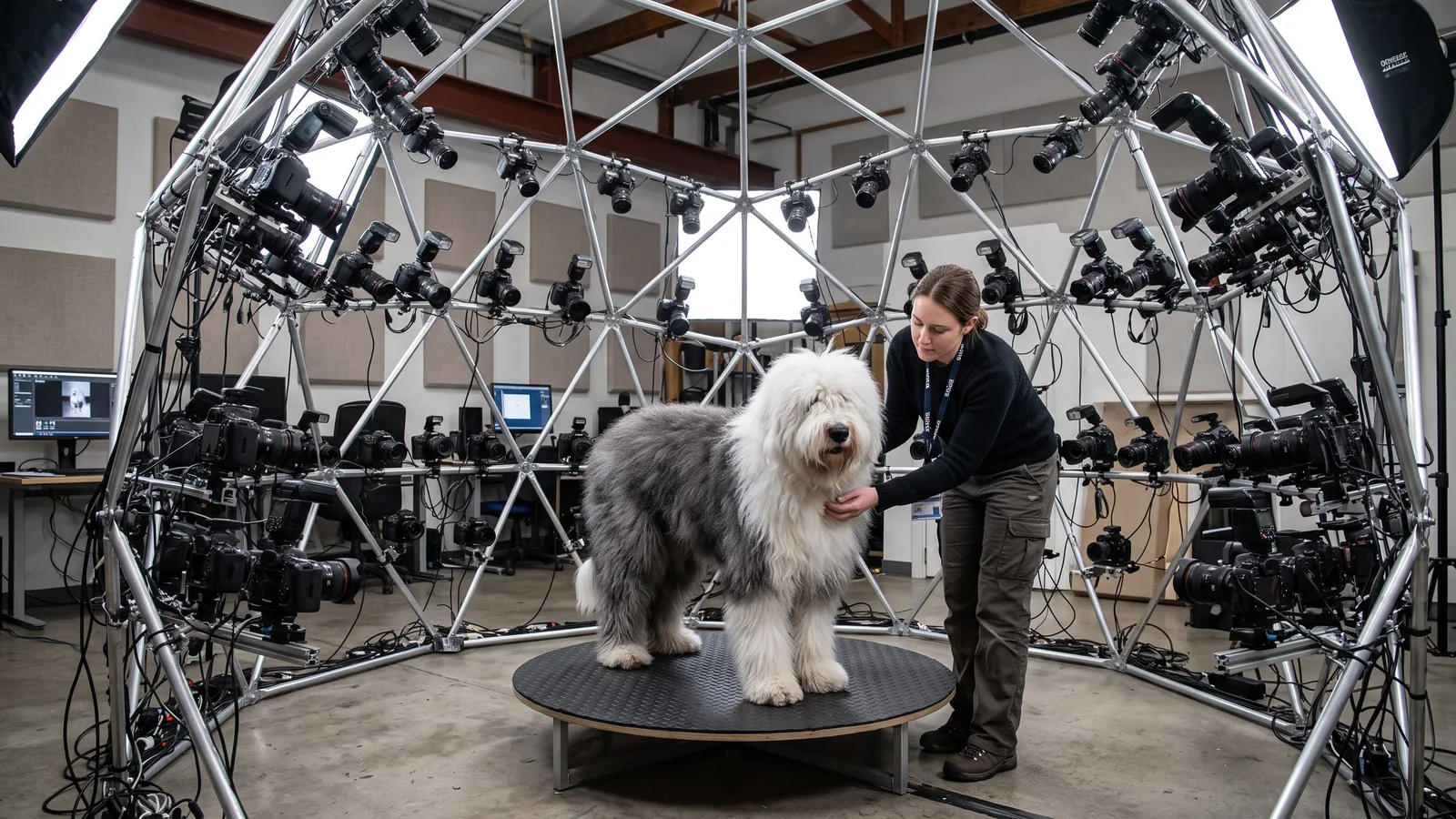
The Old English Sheepdog is a one-of-a-kind scanning subject. The thick, shaggy coat that is the breed’s defining characteristic is simultaneously the most visually interesting thing about the dog and the most difficult surface to capture correctly in photogrammetry. The coat covers the face, hangs heavily from the body, moves with every breath and slight shift of weight, and has a texture that is fundamentally incompatible with standard photogrammetry reconstruction.
The breed is nonetheless commercially valuable in 3D — it appears in product advertising, family lifestyle renders, and in games where the distinctive “fluffy dog” silhouette is needed. Getting a correct Old English Sheepdog model means confronting the coat problem directly.
Why thick, long coats are the hardest photogrammetry surface
Photogrammetry reconstruction assumes that the subject’s surface is static — it reconstructs the position of surface points by triangulating them across multiple camera views, and this only works if the same surface point is in the same position in all the views.
A thick, long coat is not a static surface. Individual hairs and coat sections move continuously with the dog’s breathing, with air movement in the studio, and with the dog’s own micro-movements. The surface that camera A sees at moment T may not be the same surface that camera B sees at moment T, because the coat has shifted between exposures — even with simultaneous capture.
Additionally, a long coat has depth that photogrammetry cannot directly resolve. The surface the cameras see is the coat tips, but the coat has depth behind those tips — the undercoat, the skin, the body structure are all hidden beneath the outer coat surface. This means the scan captures the outer coat as a surface, but the outer coat surface is itself semi-transparent (individual hairs can be partially transparent at their tips) and in constant low-amplitude motion.
The result without specialized techniques is a coat surface that shows motion artifacts (blurring, doubling of coat sections), loss of coat tip detail, and incorrect surface geometry in areas where the coat hangs away from the body.
Specialized techniques for long-coat scanning
Faster capture systems. The simultaneous capture moment must be as short as possible — not just to freeze the dog, but to freeze the coat. Studio strobe flash durations of 1/2000 second or faster are necessary to freeze coat motion. Standard studio lighting at lower intensity will allow coat micro-motion to register as blur.
Coat state management. The coat must be in a specific, repeatable state for the scan. It must be clean, dry, fully brushed, and hanging naturally. Any tangles, mats, or unusual coat states will be captured and cannot be corrected in post without altering the coat geometry. The dog should be groomed in the hours before the session and kept in a stable, cool environment to prevent coat disturbance.
Supplementary coat geometry. Some studios use supplementary geometry capture for long-coat sections — dedicated close-range scans of specific coat areas with structured light scanners that capture depth information rather than relying on photogrammetry feature matching. This provides more accurate coat surface geometry for the most critical areas (the face, the coat fall along the back) that photogrammetry struggles with most.
Face geometry under the coat
The Old English Sheepdog’s face is fully covered by the coat in a natural state. The eyes are hidden, the muzzle is partially covered, and the dog’s head reads as a round, furred mass rather than a structured face. This is the breed’s visual identity, but it is also the reason that face geometry capture is different from every other breed.
The face capture problem. To capture the dog’s facial structure — which exists under the coat and is identifiable if the coat is parted — requires either manually parting the coat in key areas or accepting that the face geometry in the final model will represent the coat surface rather than the face. For most use cases, the coat surface representation is correct — the Old English Sheepdog in a render will look exactly as it does in life, with the coat covering the face. For specialized uses that require facial rigging or expression, the structural face geometry needs to be captured separately.
What a correctly scanned Old English Sheepdog provides
Authentic coat surface geometry. The specific coat fall, the thickness, the direction of the coat over the back and sides — these are captured from the actual dog rather than sculpted or generated procedurally.
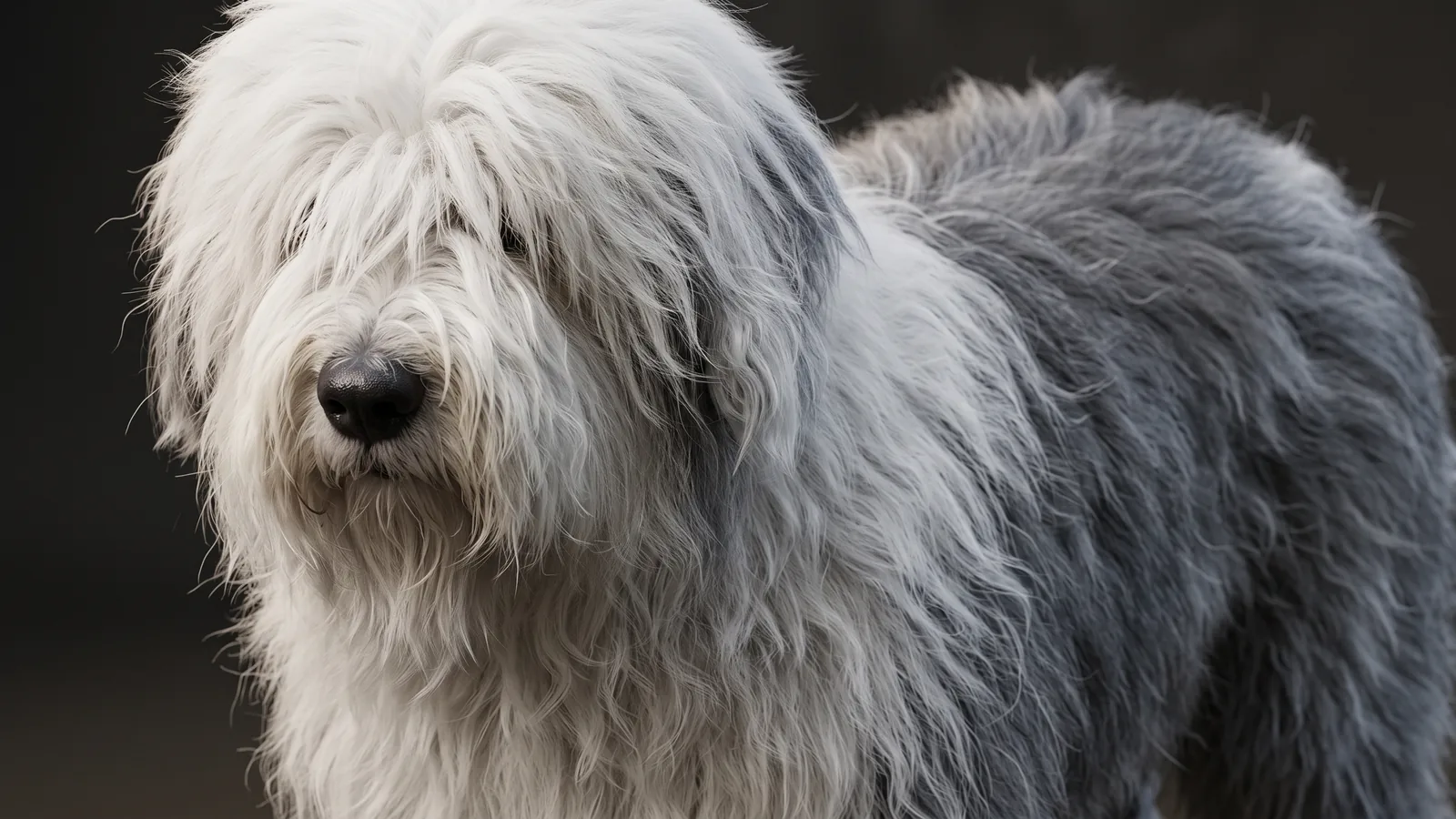
Silhouette accuracy. The Old English Sheepdog’s distinctive round, shaggy silhouette — the coat-covered face, the heavy body coat, the paw-covering leg furnishings — is what makes the breed identifiable at any distance. A correctly scanned model has this silhouette.
Coat color and texture. Old English Sheepdogs are blue-gray and white, with the two colors distributed across the body in a characteristic pattern. The photogrammetry texture maps capture this color distribution accurately.
The Renderbot Old English Sheepdog 3D model is scanned using high-speed strobe capture and coat preparation protocols developed for long-coat breeds.
Comments
No comments yet.