


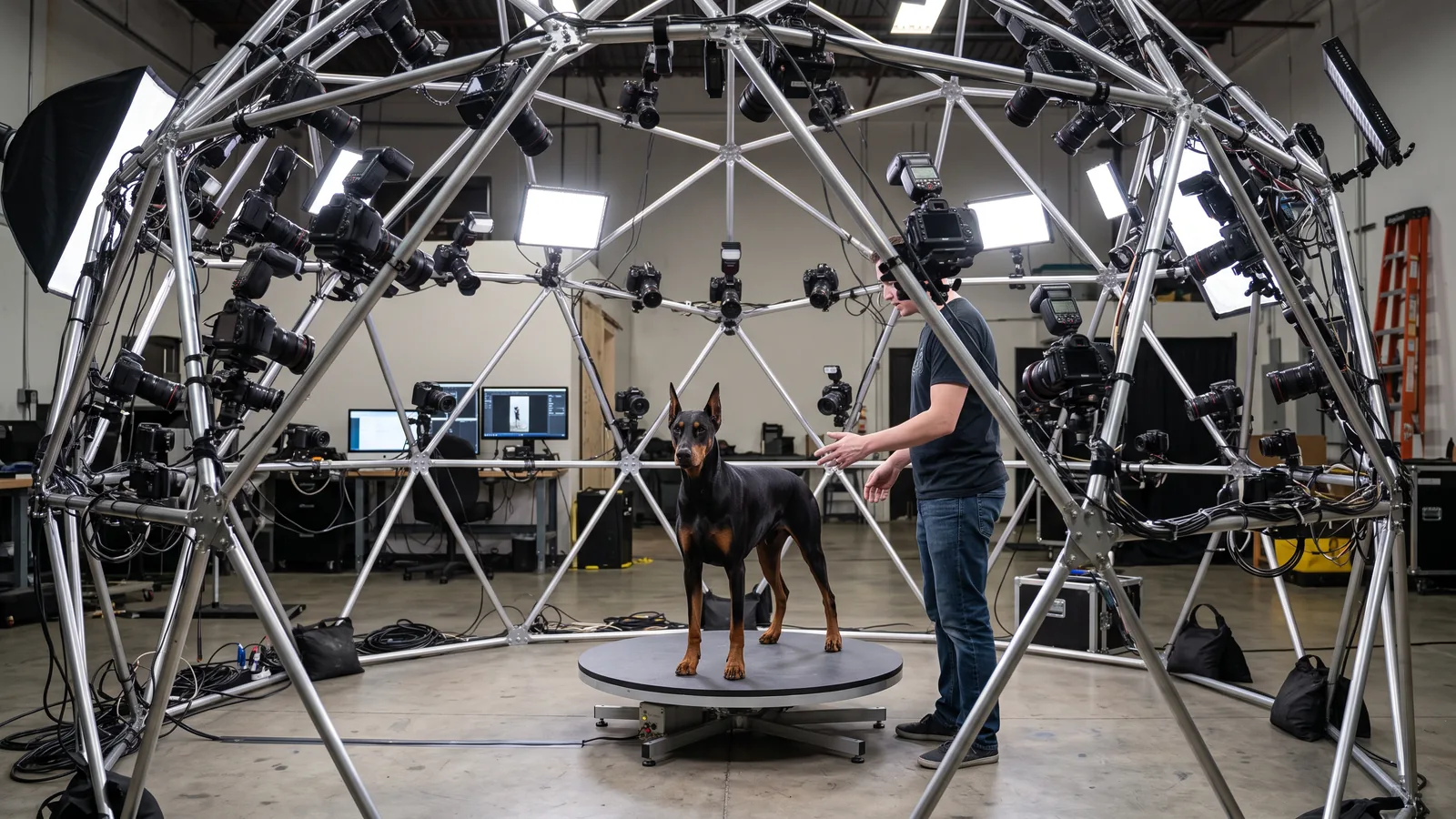
The Doberman is a breed that, geometrically, should be easy to scan. The coat is extremely short and flat — almost no fur geometry. The body is muscular and lean, with clear surface definition. The characteristic tan point markings at the muzzle, brows, chest, and legs provide high-contrast texture that aids feature matching. The breed’s natural alert posture — upright, with erect ears and a forward weight distribution — is precisely the pose that produces the most useful 3D model.
The problem is behavioral. The Doberman is a working protection breed with high environmental awareness, strong territorial instincts, and a stimulus threshold that is calibrated for detecting threats. A multi-camera photogrammetry rig, with 60–100 unfamiliar black objects surrounding the dog at various heights, looks exactly like a threatening enclosure to a Doberman encountering it for the first time.
How the camera rig reads to a Doberman
Photogrammetry studios use dense camera arrays — typically cameras mounted on aluminum or carbon fiber rails in a dome or cubic configuration, surrounding the subject from every angle. At chest height for a Doberman, these cameras are at eye level, positioned close (typically 1.5–2.5 meters from the subject), and facing the dog directly.
A Doberman’s response to this arrangement, without prior training, is typically one of two extremes: high alertness with rigid posture (the dog stands very still but with every muscle tense, ready to respond, in a state of fight-or-flight) or active investigation and movement (the dog moves to investigate each camera, invalidating the capture). Neither produces usable scan data.
The rigid alertness state can produce a usable body scan — the dog is not moving — but the face will show stress signals: furrowed brow, tight muzzle, stiff lip corners. These are not neutral Doberman expressions and will be present in every frame, producing a scan that shows an anxious dog rather than a calm one.
The active investigation state produces only blur.
The correct state for a Doberman scan is calm attentiveness — the dog is aware of the environment, is not anxious about it, and is focused on the handler rather than the cameras. This state is achievable but requires either a Doberman with specific training in novel environments, or extensive pre-session acclimatization work.
Handler requirements for Doberman scanning
Dobermans are handler-sensitive dogs — they build strong relationships with their primary handlers and may be cooperative with that handler in conditions where they would refuse cooperation with a stranger. For a scan session, this means:
The dog’s own handler should be present and directing. A professional handler unfamiliar to the dog is a suboptimal substitute. The dog will respond to its known handler’s cues more reliably than to a stranger’s, particularly in a high-stimulus environment.
The session requires rehearsal. A Doberman handler experienced in scanning knows how to bring the dog into the rig, position it in the correct body orientation (facing the main camera array, weight balanced on all four feet, head at the correct height), and release the dog between capture attempts without breaking the session flow. This is not improvised management — it is a scripted procedure.
Alert without arousal. The target behavioral state — alert posture without arousal — requires specific communication cues. The handler must signal to the dog that the environment is worth attending to but not responding to. For most Dobermans, this involves a specific attentiveness cue and a neutral environment posture signal that the handler has built into the dog’s behavioral repertoire.
Geometric challenges specific to the Doberman
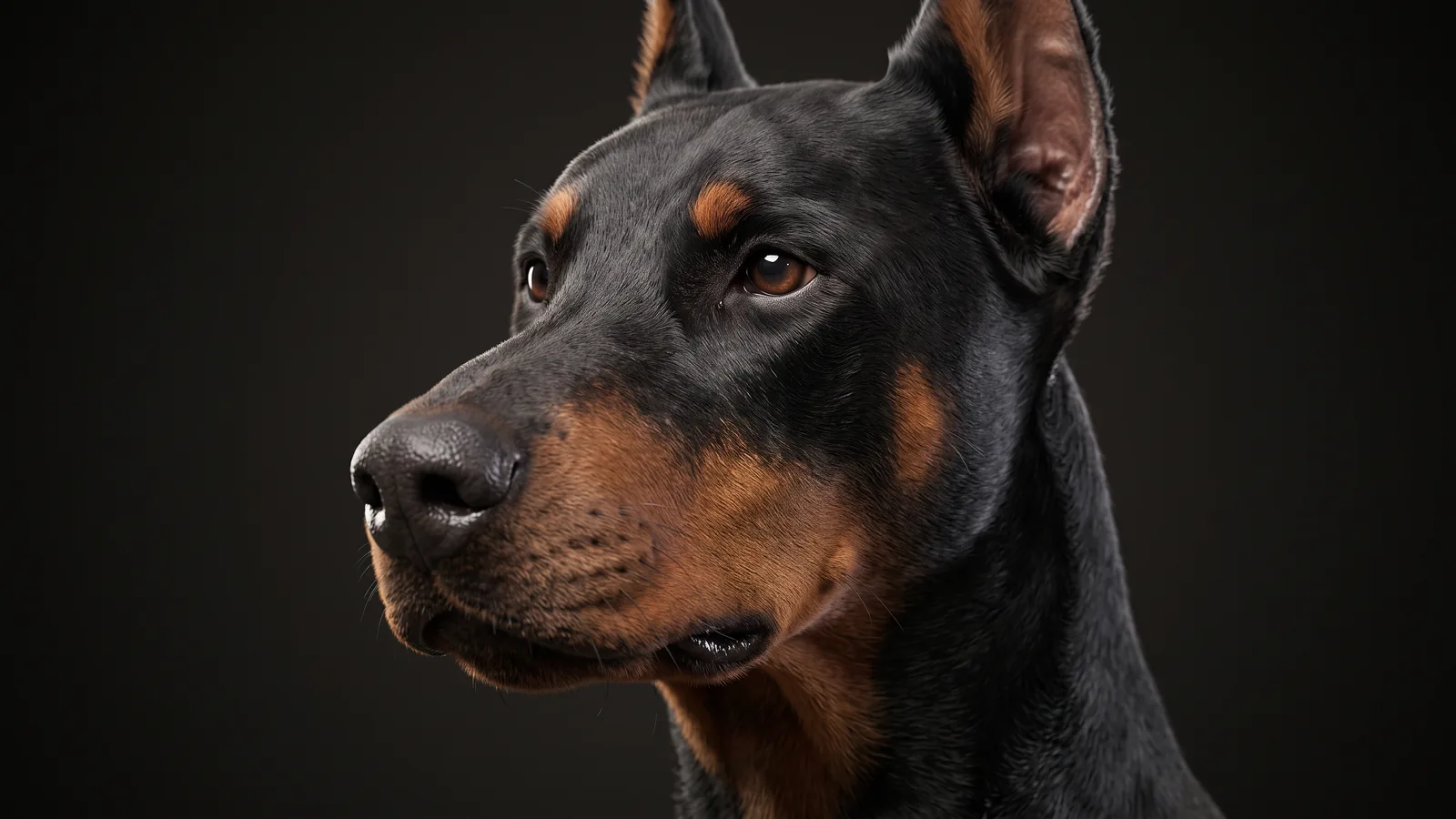
Ear cropping variants. Doberman ears are either natural (drop ears, folded at the base) or cropped (upright, various cropping styles depending on the country and breeder preference). These are geometrically and silhouette-significantly different. A model with cropped ears will not read correctly as a Doberman with natural ears, and vice versa. The scan session specifies which variant is being captured, and the rig is adjusted accordingly — natural ears require coverage from below to capture the fold geometry; cropped ears require coverage of the pointed ear tip.
Deep chest geometry. The Doberman’s deep chest — the breed standard specifies a chest depth that reaches to the elbow — requires cameras positioned at floor level to capture the sternum and underside geometry correctly. Without this, the chest depth is underrepresented in the model.
Docked tail geometry. Dobermans are frequently shown with docked tails. A docked tail is a specific geometric shape — not simply a short tail, but a healed surgical end with specific surface characteristics — that requires dedicated capture at close range.
The Renderbot Doberman 3D model is scanned from a Doberman with established studio familiarity, using a handler protocol developed for high-alertness working breeds.
Comments
No comments yet.