


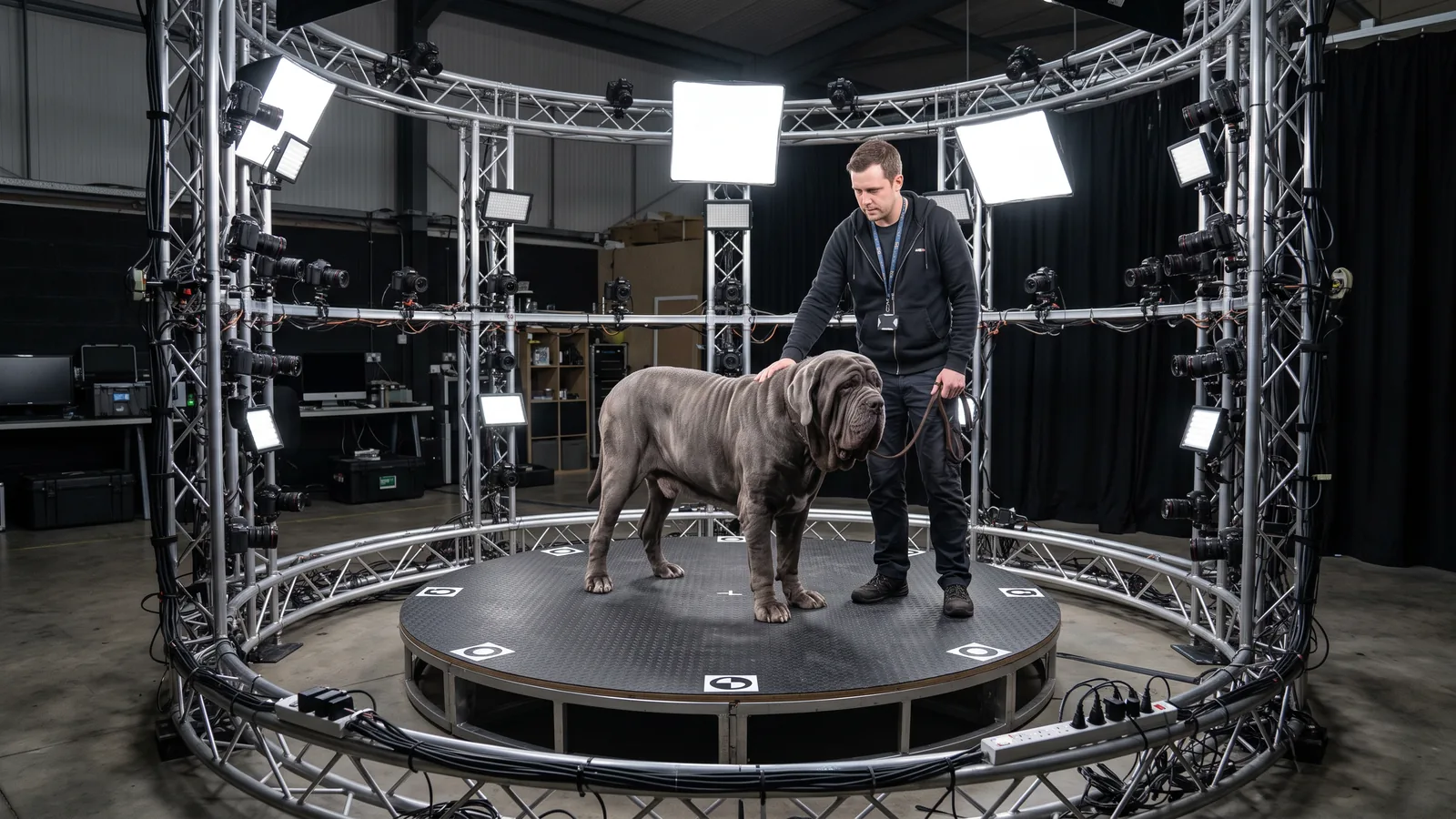
The Neapolitan Mastiff — the Mastino Napoletano — is an ancient breed descended from the war dogs of Rome. Its defining characteristic is not its size (though it is very large) but its skin: the breed has an extraordinary amount of loose skin that hangs in folds over the face, neck, body, and legs. This skin fold complexity makes the Neapolitan Mastiff one of the most technically demanding dogs to scan correctly.
The commercial value of a correct Neapolitan Mastiff model is high — the breed’s visual impact in games, film, and advertising depends entirely on the skin folds being correct. A Mastino with smooth skin is simply a large dog. A Mastino with correct fold geometry is an immediately recognizable, visually distinctive asset.
Skin folds as a photogrammetry problem
The same fundamental problem that makes the French Bulldog’s nasal fold difficult to scan applies to the Neapolitan Mastiff at every scale: deep concave surfaces are shielded from most camera angles, shadowed in most lighting conditions, and produce reconstruction artifacts in standard photogrammetry software.
For the Mastino, this problem is pervasive across the entire dog:
The dewlap. The dewlap — the deep fold of loose skin hanging from the throat — is a large concave structure. The interior of the dewlap fold, where the two sides of the skin drape together, cannot be seen from any camera position that is also covering the rest of the dog’s body. Dedicated cameras positioned directly in front of and below the dewlap are required, along with direct lighting into the fold.
The facial wrinkles. The Mastino’s face is covered in deep wrinkles and folds around the muzzle, over the eyes, and at the cheeks. These are not shallow surface textures — they are geometric folds where one surface overlaps another by several centimeters. The interior of each fold is a pocket of shadow that the cameras see only at extreme low angles.
Body skin excess. The loose skin over the body — particularly the shoulder area, the flanks, and above the legs — creates multiple smaller folds that form wherever the dog shifts its weight. These folds are variable: they form and dissolve with the dog’s movement, which means the scan must be captured at a moment when the folds are in a characteristic, stable configuration.
Lighting for fold geometry
Standard photogrammetry studio lighting is designed to provide even, diffused illumination that minimizes shadows on the subject surface. For a Neapolitan Mastiff, this approach fails: without directional light reaching into the fold interiors, the folds are uniformly dark, and the photogrammetry algorithm cannot reconstruct surfaces it cannot see.
The solution requires a multi-component lighting setup:
Primary diffused lighting for the main body surfaces — identical to standard dog scan lighting.
Secondary directional lighting at multiple specific angles to push light into fold interiors. This requires small, high-intensity light sources at low angles, positioned to target specific fold areas. For the dewlap, a small light source positioned directly below and in front of the fold is typically needed. For the facial folds, low-angle sources from the front and sides.
LED ring or fiber optic fill for the deepest fold interiors where even directional sources cannot reach at sufficient intensity. This is a close-range fill solution that provides just enough light into the fold to give the reconstruction algorithm surface information.
Managing this multi-component lighting setup while maintaining consistent light across the full body for the main reconstruction requires careful calibration and test captures to verify coverage before the dog is in position.
The Mastino’s size and temperament in the studio
The Neapolitan Mastiff is a giant breed — males typically weigh 60–70 kg. The studio infrastructure needs to be rated for this weight on the scan platform, and the platform size needs to accommodate a dog whose body mass is significantly larger than most of the studio’s standard subjects.
The breed’s temperament is notable for its combination of extreme loyalty to its handler and extreme suspicion of strangers and unfamiliar environments. A Mastino that trusts its handler will cooperate in an environment the handler signals as safe. A Mastino that is uncertain — in a novel environment with an unfamiliar handler — may be immovable. The dog’s sheer mass means that physical management approaches are not viable options.
Handler familiarity is non-negotiable for the Mastino. The dog must be scanned with its own handler present and directing. No studio handler substitute will produce a cooperative result with a Mastino that does not know them.
What a correctly scanned Neapolitan Mastiff provides
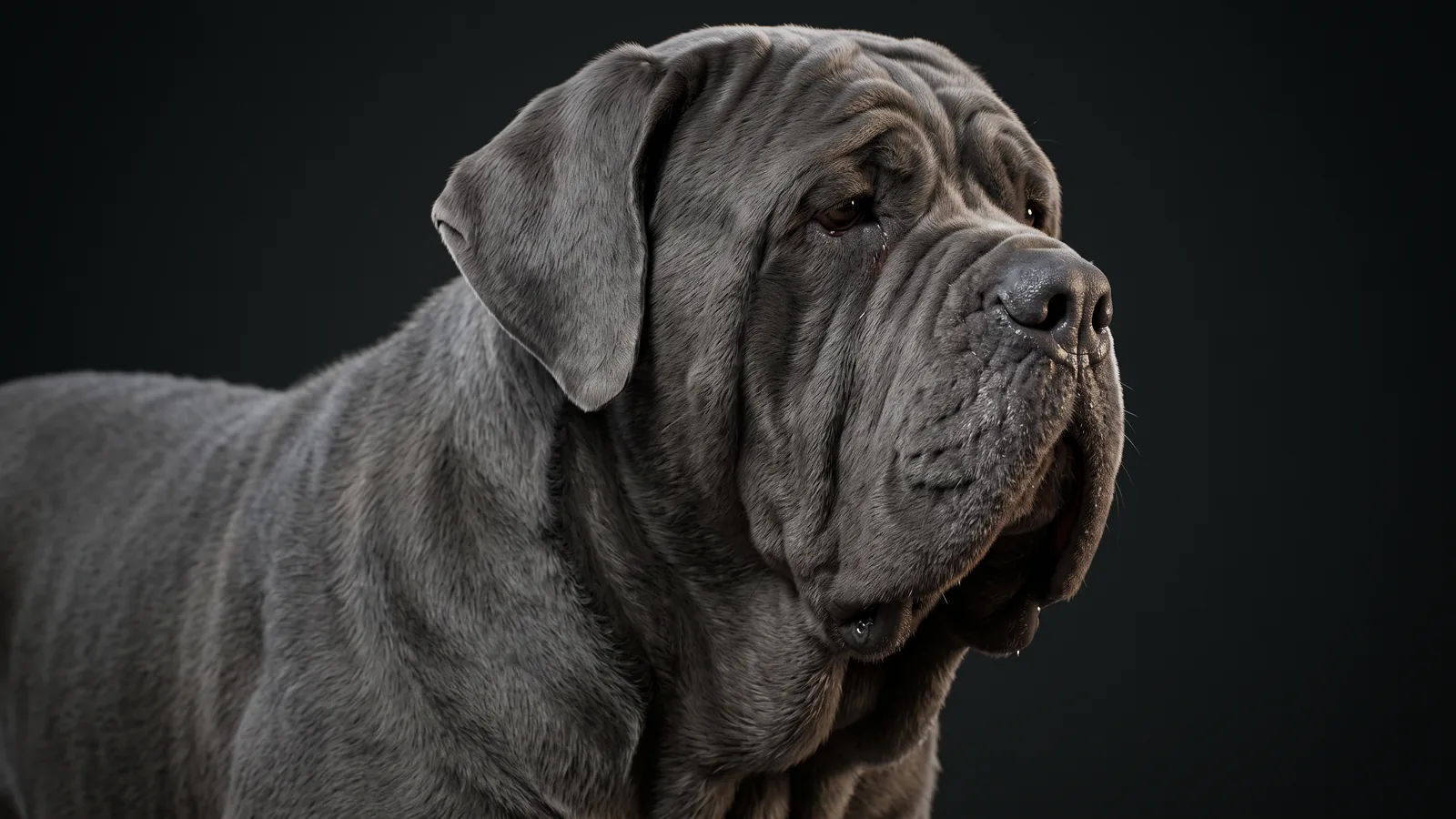
Accurate fold geometry. The dewlap depth, the facial wrinkle structure, and the body skin fold configuration are what distinguish a Mastino model from a generic large dog. Correct fold geometry makes the breed immediately recognizable.
Massive body proportions. The Mastino’s body proportions — the extremely broad head, the deep chest, the heavy bone structure, the low-slung build — are captured accurately in a photogrammetry scan.
Short, dense coat texture. The Mastino’s short, slightly rough coat shows the skin movement and fold dynamics under it. The coat texture is captured in the photogrammetry maps.
The Renderbot Neapolitan Mastiff 3D model uses a specialized multi-component lighting setup developed for heavy-fold breeds, combined with a handler protocol for giant-breed scan sessions.
Comments
No comments yet.