


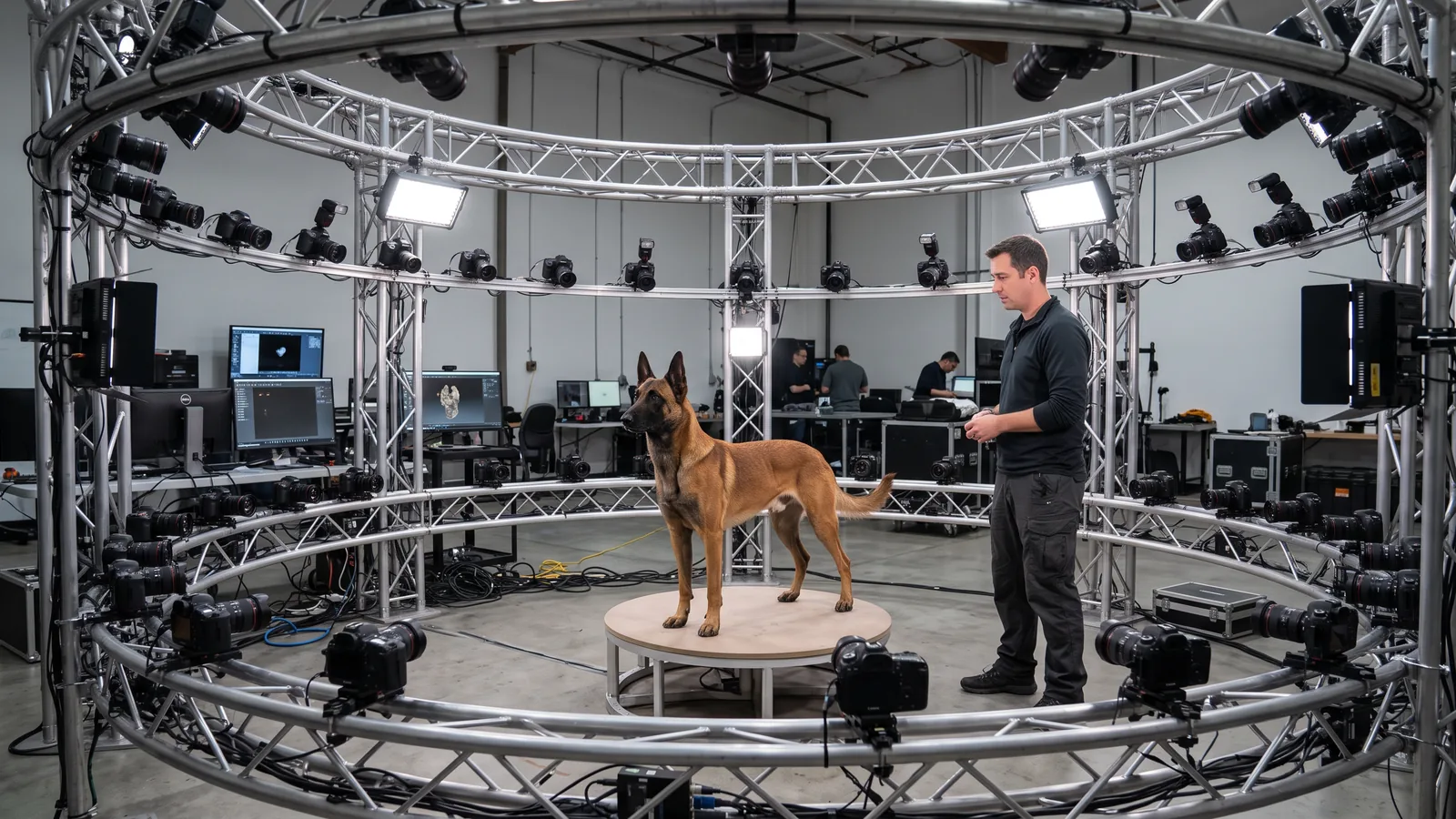
The Belgian Malinois is the breed of choice for military, police, and security work globally — a role it holds because it is fast, intelligent, physically capable, and driven by a work ethic that is essentially impossible to exhaust. This drive makes the Malinois exceptional at every task it is trained for. It makes photogrammetry scanning one of the more challenging handler-management problems in the studio.
The Malinois is in demand as a 3D model precisely because of its profile — military and police visualization, game development (the breed appears in several major game titles), and commercial work for dog equipment manufacturers. Getting a correct Malinois scan means managing a dog that is wired to respond to every stimulus in its environment and cannot voluntarily be in a state of relaxed inactivity.
Why drive and stamina work against scanning
A photogrammetry scan requires the dog to be stationary for a brief but complete capture moment — typically one to three seconds during which all cameras fire simultaneously. For most dogs, the challenge is getting enough stillness for this duration. For a Malinois, the challenge is different: the dog is completely still, but it is still in an anticipatory state.
The Malinois has been selectively bred for generations to anticipate work. Any novel stimulus — a person entering the room, a camera clicking, an equipment adjustment — is interpreted as a potential task cue. The dog is constantly monitoring for the moment when it will be asked to do something. This anticipatory state is visible in the body posture: weight on the front feet, muscles slightly tensed, head moving to track any new stimulus, ears up and rotating.
This is a good pose for a 3D model — it communicates the breed correctly. But the continuous monitoring means the head and ear position change between scan captures when the environment changes, and the small constant micro-movements of the body produce motion blur in anything but a simultaneous multi-camera capture.
The simultaneous capture requirement
For a Malinois scan, there is no alternative to a fully simultaneous multi-camera setup. Sequential capture systems — where cameras fire one at a time or in groups — will produce a series of frames showing the dog in slightly different positions as it tracks stimuli between shots. Even 0.5 seconds between captures is too long for a Malinois in an active scan environment.
A simultaneous capture setup fires all cameras within the same flash duration — typically 1/1000 second or faster with dedicated studio strobes. This freezes any motion completely. The Malinois can be moving slightly at the moment of capture and still produce a clean scan.
Handler protocol for Malinois scanning
Use a working-dog handler with Malinois experience. A handler who works with Malinois in operational contexts — military, police, sport Malinois competition — understands the breed’s behavioral structure. They know the specific cues that bring the dog into a focused but contained state, and they know how to prevent the anticipatory drive from tipping into full arousal.
Obedience position (Platz or Stand). A Malinois with working obedience training will hold a Stand command reliably and without tension if the handler maintains the right behavioral context. The Stand position for a working Malinois is not a relaxed pose — it is an attentive military-style stand — but it is consistent, which is what the scan requires.
Manage the stimulus environment. Equipment adjustments, camera checks, and other non-capture activities should be performed before the dog enters the scan area. Every change in the environment after the dog is in position will trigger a stimulus-response from a Malinois. Minimizing changes after the dog is set up reduces the number of head-tracking movements that need to be captured over.
What a correctly scanned Malinois provides
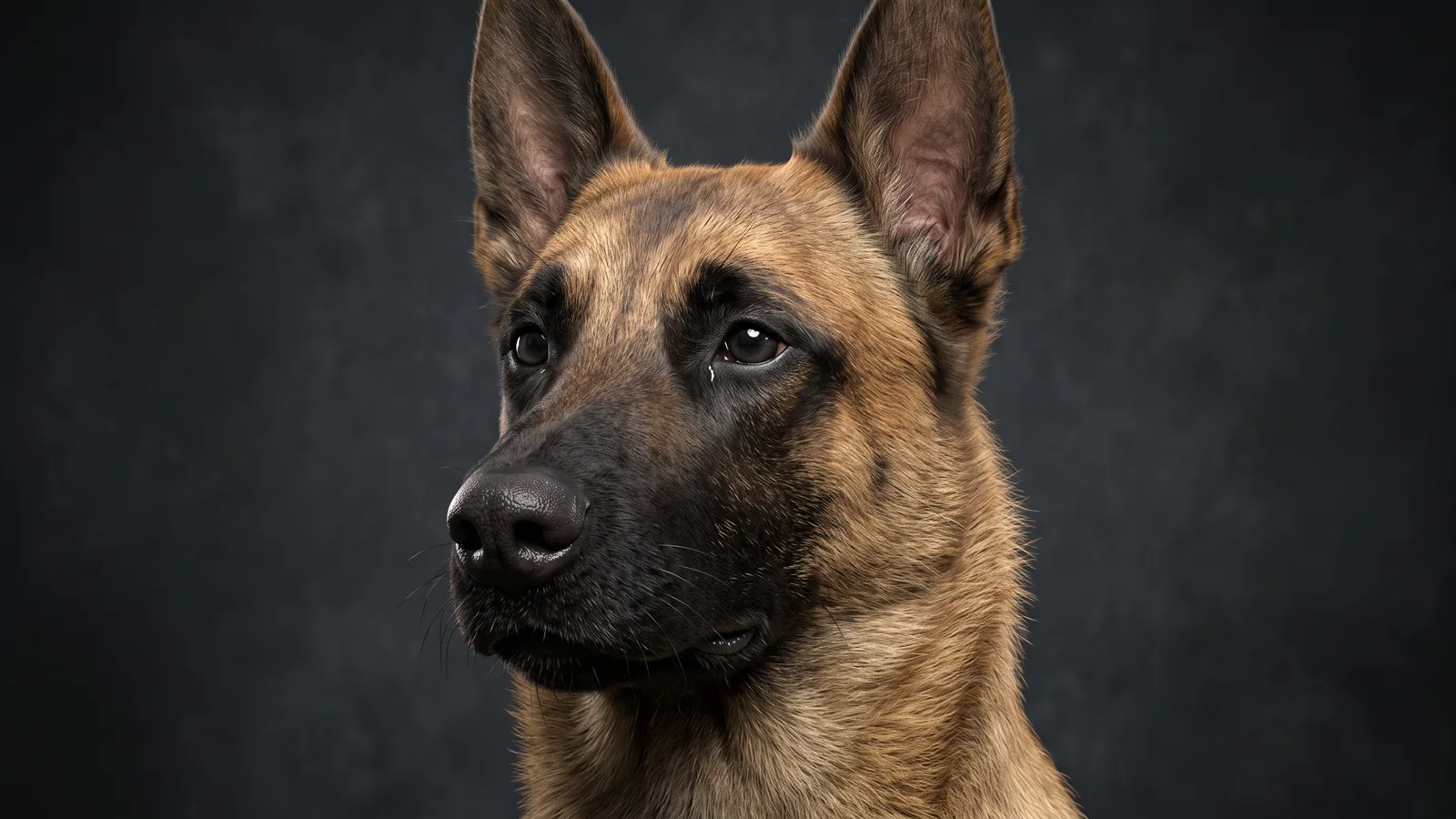
The alert working posture. The Malinois in its natural working posture — weight forward, ears up, alert expression — is what the market needs. A correctly scanned Malinois in this posture communicates the breed immediately.
Black mask accuracy. The black mask marking, extending from the muzzle across the eye areas, is the primary identifying marking. Its specific shape is captured in the photogrammetry texture.
Short fawn coat. The Malinois has a short, dense, slightly rough coat that shows the musculature clearly. The coat lies flat and provides good texture contrast for photogrammetry reconstruction.
The Renderbot Belgian Malinois 3D model is scanned from an active working-dog-trained Malinois using a simultaneous capture protocol with experienced working-dog handlers.
Comments
No comments yet.