


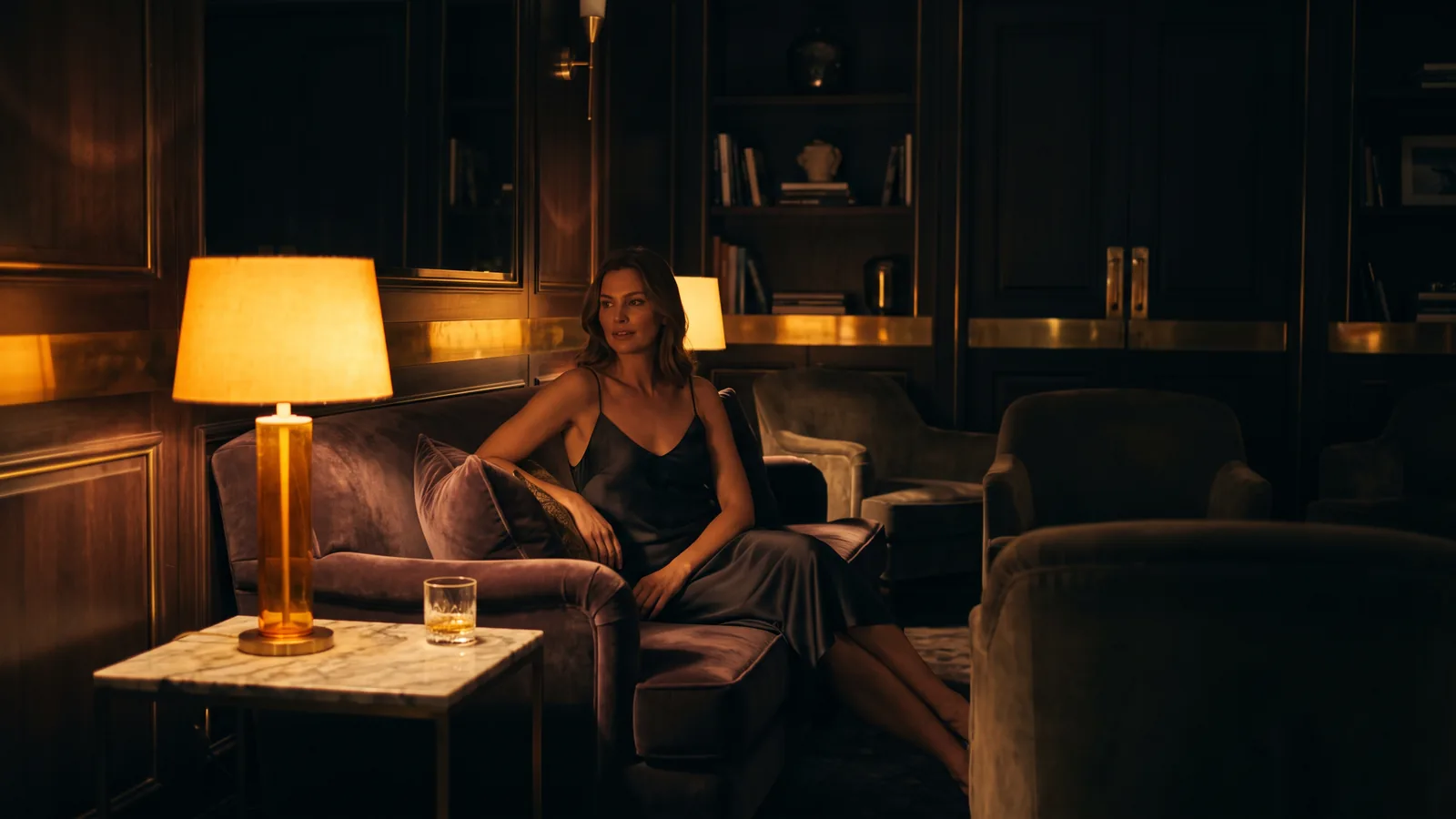
Evening lounge and private bar interior renders occupy a specific visual register: dark, atmospheric, intimate, aspirational. The architectural materials are rich — velvet upholstery, polished brass, lacquered surfaces, marble, leather — and the light is minimal and carefully placed. This is not morning light arch viz or daytime residential photography. It is closer to the visual language of a Helmut Newton editorial or a cocktail lounge promotional photograph.
A topless figure in this environment is natural to the register. The low-light, moody interior is one of the contexts where a topless female figure is most visually appropriate and compositionally effective. The body in this light is not fully revealed — it is suggested, partially lit, partially shadow. The drama comes from what is shown against what is concealed.
Low-key lighting and its technical implications
Low-key interior lighting — where the dominant mode is shadow rather than light — creates specific render challenges for a figure:
High contrast skin rendering. In a room lit by a single lamp or a small cluster of practical light sources, the figure will have a very high contrast ratio between the lit side and the shadow side. The lit side may be at full exposure; the shadow side may be nearly black. The skin needs to retain detail and interest in both extremes. A photogrammetry-scanned figure provides surface detail in the shadow areas that a hand-modeled figure will lose — the pore structure, the micro-topology, the natural variation of the skin surface are still present in deep shadow, even if they require careful GI settings to reveal.
Warm color temperature practical lights. Lounge and bar interiors typically use very warm practical light sources — incandescent or halogen equivalents, candles, warmly tinted LED — in the range of 2200–2700K. At these color temperatures, the light on the skin is strongly orange-tinted, and the skin’s warm undertones are amplified. The SSS color should be calibrated to this warm ambient. The near-side scatter (surface and near-field SSS) will be strongly warm; the deep-scatter channel can remain neutral or slightly warm.
Multiple practical sources at varying intensities. A lounge interior often has multiple small light sources — table lamps, candles, recessed accent lighting, bar backlighting — all at slightly different positions and intensities. A figure in this environment is lit by a complex mix of small sources rather than a single dominant one. The result is a soft, multi-directional warm light with gentle shadows from each source overlapping. This reduces the dramatic single-source chiaroscuro but creates a warm, enveloping quality.
Reflective materials. Lounge and bar interiors use highly reflective materials — polished brass, lacquered surfaces, mirror panels, polished stone — that create secondary light bounces and reflections of the figure. A figure standing near a brass surface will receive a warm fill bounce from that surface. A figure near a mirror panel will produce a reflection that shows an additional view of the figure in the composition.
Compositional conventions in evening interior renders
Evening lounge renders have established compositional conventions borrowed from interior photography, editorial fashion, and hospitality marketing:
The figure as the light source. In an otherwise dark room, a lit figure becomes the dominant visual element. The composition can treat the figure as the warm anchor of the frame, with the architecture receding into dark ambient around it. This reverses the typical arch viz relationship — the figure, not the architecture, provides the light and warmth that the eye is drawn toward.
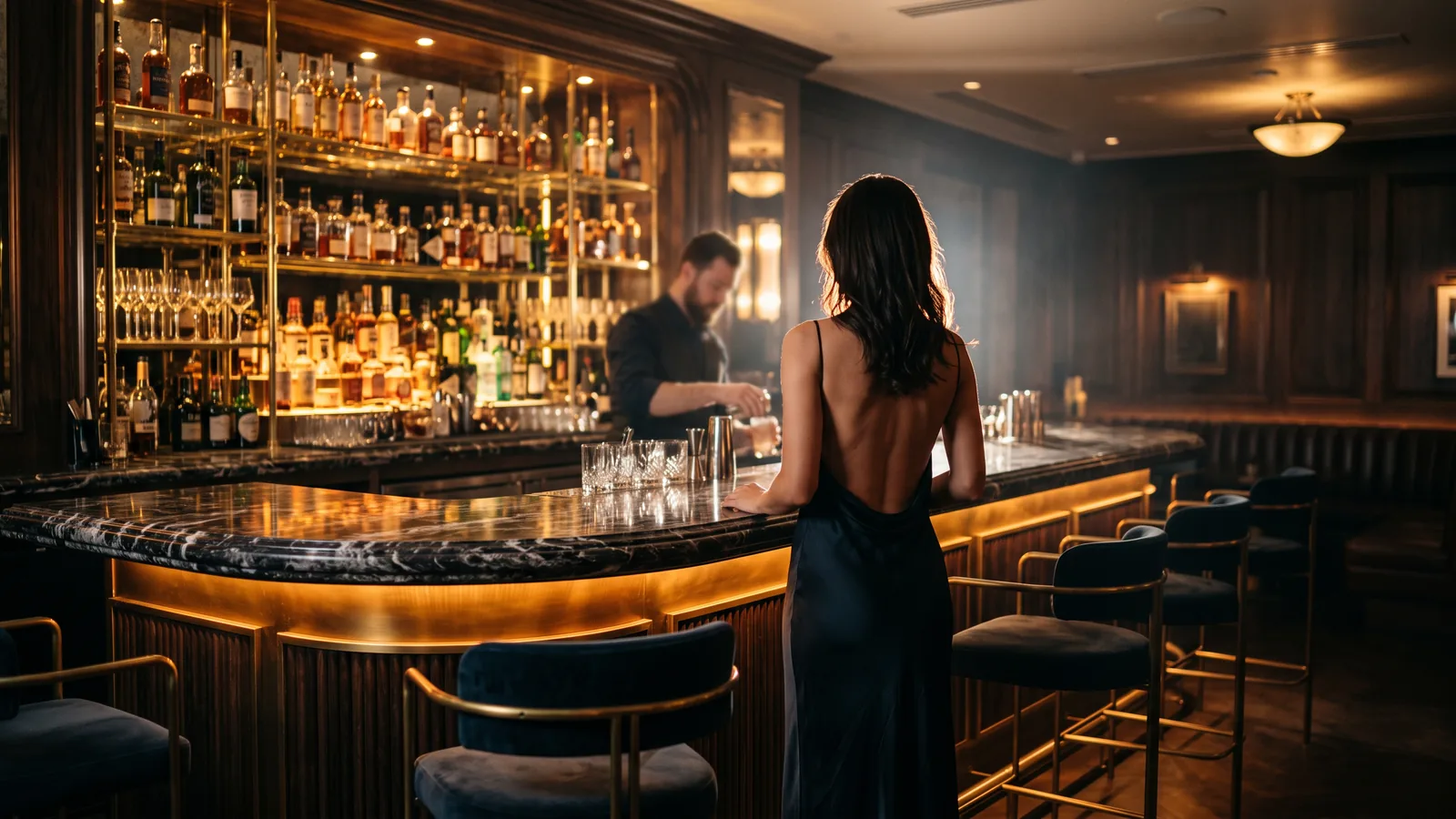
Partial figure. Evening lounge renders frequently show only part of the figure — from the waist up, from behind, or as a silhouette against a backlit surface. The partial view, in combination with the low light, creates the suggestion of a body in a space without full revelation. This is consistent with the visual language of lounge and club photography, where atmosphere is built through implication as much as explicit representation.
Deep background and depth. Lounge interiors typically have significant depth — a bar receding into the background, a series of booth seating arrangements, a view to an exterior terrace. A figure in the foreground against a deep dark background creates natural compositional depth, with the figure as the near, warm element and the room extending into relative darkness behind.
The occupied chair or sofa. A topless figure seated on a lounge sofa or bar stool communicates the experience of the space from the inside — the quality of the upholstery, the height of the bar, the ambience of the room as it is felt by an occupant. The seated or reclining figure also allows lower camera positions, which are characteristic of lounge photography.
The nightclub and event space
Nightclub and event space renders extend the lounge register into higher-intensity light conditions:
Colored theatrical lighting. Nightclub renders use theatrical lighting — moving heads, LED wash lights, strobes, UV sources — in saturated colors (red, blue, purple, green). A topless figure in colored theatrical light will have skin tones that are significantly shifted from any natural color — full red on the lit side, cyan in the shadow areas under a red light. This is a stylized rendering condition that is explicitly not naturalistic. The SSS parameters should be adjusted to allow the skin to respond to colored light rather than maintain warm neutrality.
High-intensity backlight and silhouette. A strong backlight from a stage-level source creates a full silhouette of the figure against a bright, potentially colored light. The figure’s surface details are lost; the composition reads entirely in terms of silhouette shape, the light halo around the figure, and the surface quality of the lit elements in the foreground.
Haze and volumetric light. Nightclub spaces frequently use atmospheric haze to make light beams visible as volumetric shafts. A figure in volumetric light appears embedded in the light itself — the light wraps around the figure and scatters off the haze in the near-camera field, creating a painterly, atmospheric quality that is distinct from clean architectural rendering.
The Renderbot library includes scanned female figures in seated, standing, and posed configurations suitable for lounge, bar, and hospitality interior presentations.
Comments
No comments yet.