


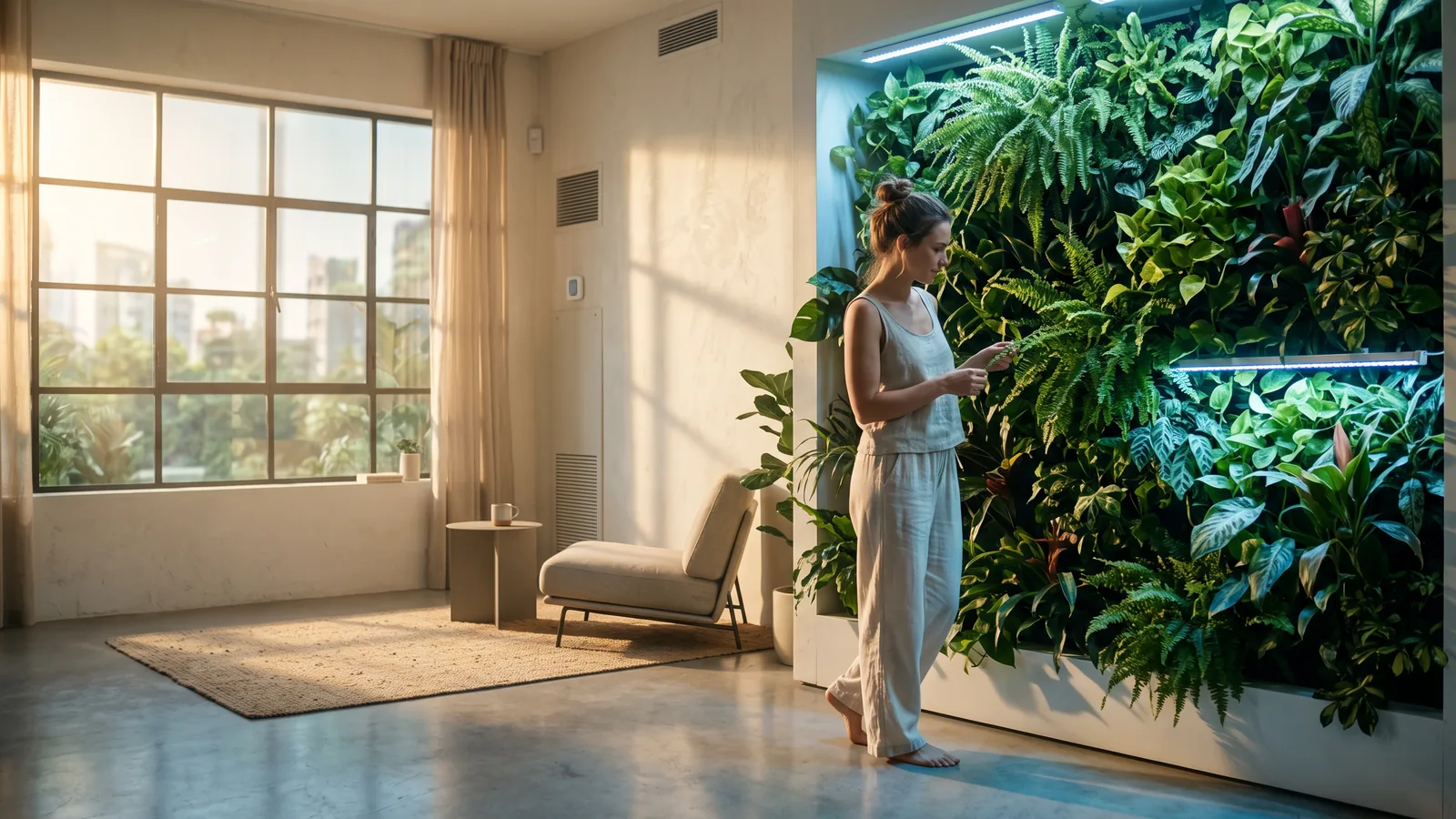
Near-future residential design — smart home concepts, biophilic architecture, speculative interior design — represents one of the most technically and creatively interesting contexts for topless figures in arch viz. These renders exist at the intersection of documentary (what will housing look like in 20 years?) and aspirational (what could domestic life be like?), and the topless figure in this context is a figure in relationship to radically changed domestic conditions.
The key difference from contemporary residential arch viz is that the architecture in a near-future render is itself a character — surfaces that respond, walls that grow, lighting that adapts to circadian rhythms. The figure in this space is not simply an occupant. It is a participant in a technologically and biologically complex environment.
Biophilic interiors and the organic figure
Biophilic architecture — which integrates natural systems (living plants, water features, natural materials, natural light cycles) into the building fabric — creates one of the most visually rich environments for a topless figure. The render frame will typically contain multiple organic textures simultaneously: skin, leaf surfaces, wood, stone, moss. The figure’s skin is one of many natural surfaces competing for the eye’s attention.
This density of organic texture requires specific compositional management:
Figure isolation. To prevent the figure from disappearing into a background of equally complex organic surfaces, the camera depth of field should slightly defocus the living wall or plant background, keeping the figure in sharper focus. Alternatively, the figure can be placed against a relatively simple surface — a white wall, a floor-to-ceiling window — with the organic elements in the peripheral visual field.
Light source from living wall. Many biophilic interiors use grow lights embedded in the living wall — typically a blue-spectrum LED that promotes plant growth. This creates an unusual ambient light condition: a blue-tinted light emanating from an organic surface. A topless figure standing near a living wall will receive blue grow-light fill from one side, which will create a cool cast in the fill areas of the skin. The warm ambient from other interior sources will balance this, creating the characteristic warm-key/cool-fill setup.
Material rhythm. The skin’s surface variation — micro-topology, pore structure, natural color variation — should read as part of the same material vocabulary as the room’s other organic surfaces. In a biophilic interior, the contrast between the figure and the room is not biological vs. synthetic (as in a sci-fi interior) but biological vs. biological at different scales. The figure’s skin is in dialogue with the texture of a moss wall or the grain of a live-edge timber shelf.
Smart home and adaptive environment renders
Smart home concept renders — spaces where lighting, climate, and surfaces are responsive and adaptive — present different compositional opportunities for topless figures:
Circadian lighting. Smart home design frequently involves lighting that changes color temperature and intensity throughout the day, following the occupant’s circadian rhythm. A topless figure in a smart home render can be shown in the morning light state (cool, activating, blue-shifted), the working day state (neutral white), or the evening state (warm, dimmed, red-shifted). These different light states produce radically different skin tone presentations and require separate SSS calibration for each.
Surface responsiveness. Speculative smart home design includes walls that change opacity, color, or texture in response to the occupant. A topless figure standing near a wall that is transitioning — becoming opaque, changing color, or revealing an embedded display — creates a compositional moment that is unique to this genre. The figure is at the threshold between the organic and the adaptive.
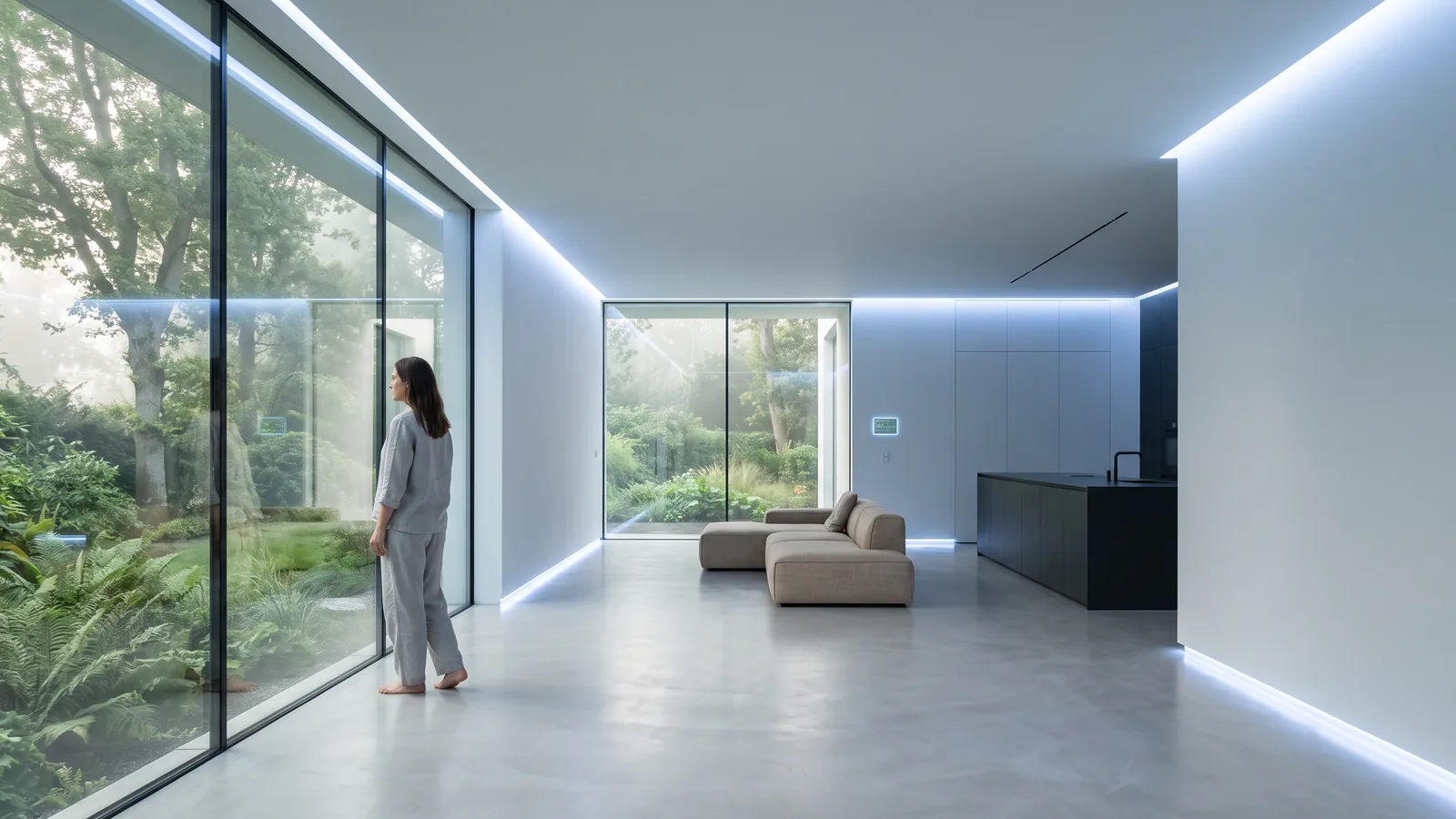
Minimal material palette. Smart home aesthetics tend toward minimal material palettes — white surfaces, transparent glass, clean geometries — that allow the technology to be legible. A topless figure against a white smart-wall renders in high contrast: the warm, complex skin against the clean, undifferentiated surface. This is a distinctive visual quality of near-future residential renders.
Speculative domestic scenarios
Near-future apartment renders frequently depict specific speculative scenarios that the topless figure can inhabit:
The post-bedroom scenario. In some near-future design concepts, the bedroom and living area merge into a single continuous space, with sleep, rest, and domestic activity all occurring in the same volume. A topless figure in this merged space communicates the dissolution of the traditional privacy boundary between sleeping and living areas.
The vertical garden apartment. Urban residential design increasingly incorporates indoor food growing and vertical gardens as domestic infrastructure. A topless figure tending plants, standing near a harvest wall, or simply sharing the frame with large-scale indoor planting creates an aspirational near-future domestic image.
The light-adaptive meditation space. Wellness-focused residential design — meditation rooms, breathwork spaces, flotation areas — often involves the most carefully controlled light environments in a building. A topless figure in a meditation space with warm bioluminescent ambient or adjustable color-temperature panels is a standard concept render for luxury wellness residential products.
The transparent-wall terrace. Floor-to-ceiling electrochromic glass that can switch from transparent to frosted on demand is a standard feature of near-future apartment concepts. A topless figure on a terrace where the glass is frosted — creating privacy without enclosure — is a composition that is uniquely possible in a speculative render context.
The Renderbot library includes scanned female figures in a range of standing, seated, and active poses suitable for near-future residential and speculative design presentations.
Comments
No comments yet.