


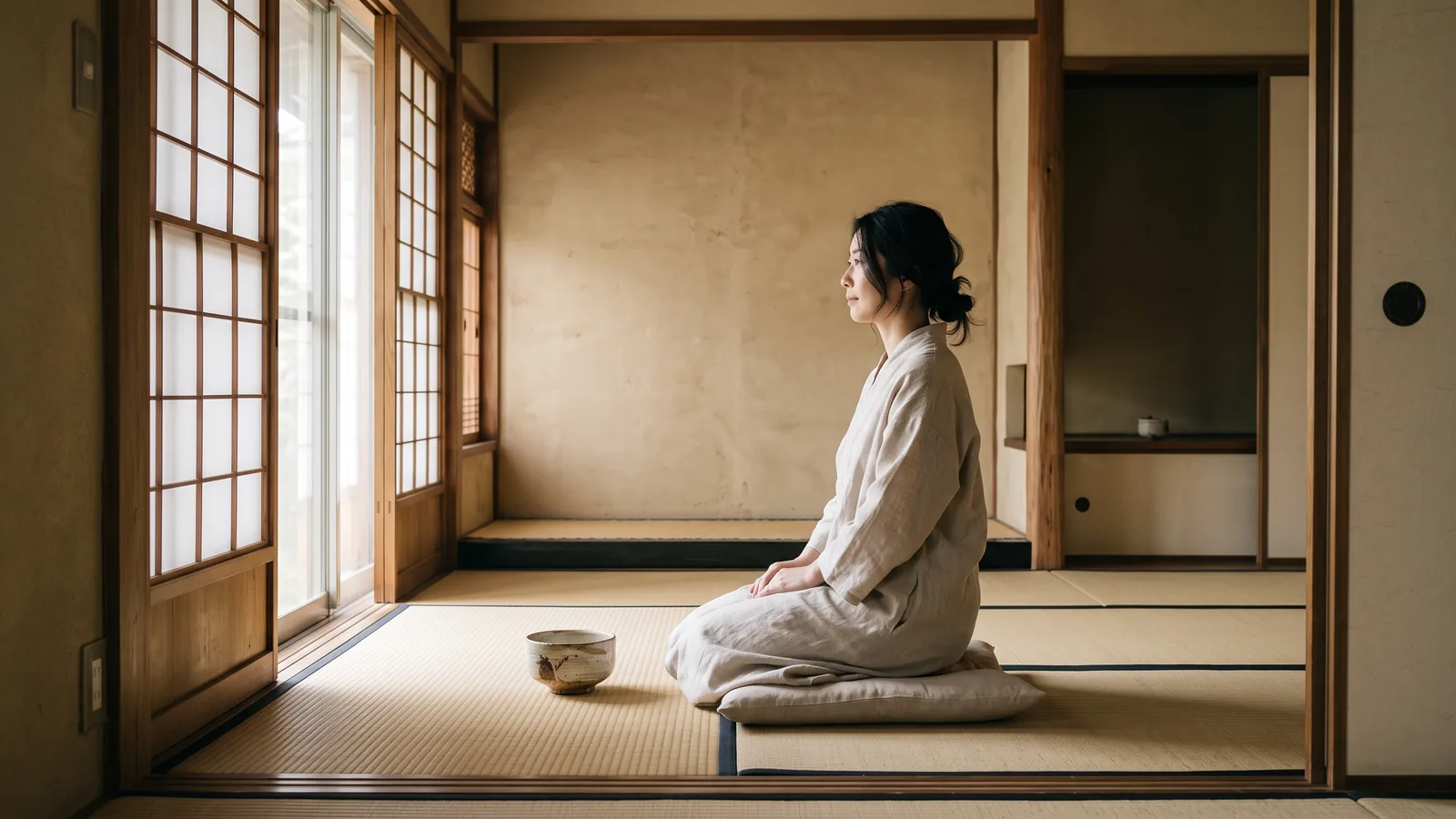
Japanese minimalist architecture — across its contemporary manifestations in wabi-sabi design, Japandi hybrid aesthetics, and traditional Zen-influenced space — has a specific relationship to the human figure that differs from Western residential arch viz. In Japanese spatial philosophy, the concept of *ma* (間) — the meaningful quality of negative space and emptiness — governs how objects, including figures, inhabit a room. A figure does not fill a space; it activates the space around it.
A topless figure in a Japanese minimalist interior render carries this reading. The figure is typically minimal in its own presentation — a neutral pose, no accessories, the simplest possible configuration of a body in a space — which allows the architecture to maintain its compositional dominance. The figure’s skin, with its warmth and texture, contrasts gently with the room’s material palette of natural linen, unfinished wood, clay plaster, and stone.
The shoji screen and diffused light
The shoji screen (障子) is the defining light modifier in traditional Japanese architecture. It is a paper-and-timber lattice screen that diffuses direct sunlight into a soft, even, slightly warm ambient. The light on the interior side of a shoji screen is one of the most distinctive and sought-after lighting conditions in interior photography and render.
For a topless figure, shoji light has specific properties:
Low directionality. Unlike a clear-glass window, which creates a bright patch of light and a distinct shadow on the opposite side, a shoji screen fills the room with diffused light that has only a gentle directional gradient. The figure will show very soft transitions from lit to shadow areas, with no hard shadow edges. This requires careful SSS tuning — without directional contrast, the skin’s subsurface scattering is the primary visual quality that distinguishes it from a matte surface.
Warm-neutral color temperature. The paper of a shoji screen has a slight warm cast that adds to the already warm quality of Japanese interior materials. The light inside a shoji-screened room is typically around 4000–5000K in color temperature — warmer than overcast sky light but cooler than lamp light. The figure in this light will show skin tones that are neither the warm-orange of lamp light nor the neutral-cool of a north window.
Shadow elimination. The floor under and around a figure in a shoji-lit room will have almost no visible cast shadow. This is correct — diffused light from a large area source does not produce hard shadows. The floor, typically tatami or polished wood, will show only the gentlest shadow gradient under the figure’s feet. This is a frequent rendering error: applying a hard shadow to a figure in soft diffused light.
The figure in wabi-sabi and Japandi interiors
Wabi-sabi design embraces imperfection, incompleteness, and the natural aging of materials. A photogrammetry-scanned figure is compatible with this aesthetic in a way that a smooth, hand-modeled figure is not — the skin’s natural variation, micro-topology, and subtle asymmetries align with the wabi-sabi appreciation for organic, imperfect surfaces.
In Japandi interiors (the Japanese-Scandinavian hybrid that combines Japanese spatial restraint with Scandinavian functional warmth), the figure typically appears in a relaxed, unhurried pose — seated in seiza or cross-legged, standing near a window, or performing a simple domestic activity like brewing tea. The topless treatment in this context signals that the moment is private and unhurried, consistent with the Japandi emphasis on slow, deliberate domesticity.
Material palette considerations. Japanese minimalist interiors are dominated by natural, low-chroma materials: unbleached linen, raw timber, clay plaster, natural stone, hand-thrown ceramics. The figure’s skin, with its natural warm tones, is one of the most saturated and texturally active surfaces in the room. Rather than competing with the room’s materials, the figure’s skin should read as belonging to the same material world — an organic surface among other organic surfaces.
Negative space. In Japanese spatial composition, the area around the figure is as compositionally important as the figure itself. The figure in a Japanese interior render is typically positioned asymmetrically, with significant negative space on at least one side. The camera framing should include enough empty space to allow the room’s silence to be felt. A topless figure in a large, nearly empty room communicates the same quality of presence and solitude that *ma* describes.
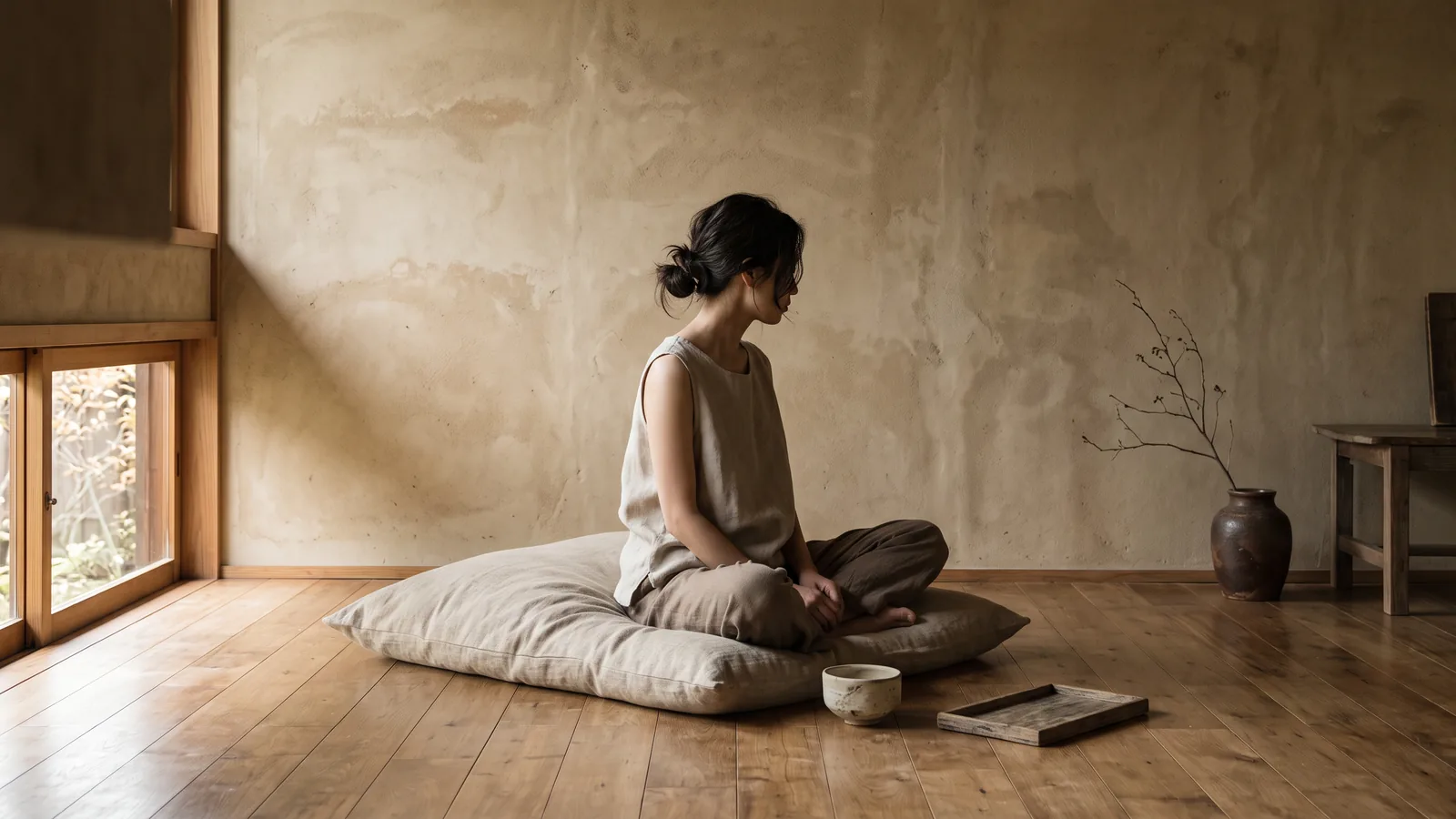
Technical notes for traditional material rendering
Japanese interiors require specific material treatments that affect the figure’s integration:
Tatami and natural fiber floors. Tatami mats have a distinctive surface pattern and a slight warm green-yellow tint. The soft ambient light in a Japanese interior will create a gentle bounce from the tatami floor onto the lower body of a seated figure — a warm, slightly yellow-green fill light from below. This bounce is subtle but contributes to the organic, interior quality of the light.
Clay plaster and earthen walls. Clay plaster walls absorb light differently than painted drywall — they scatter it more diffusely and add their own warmth to the ambient. A figure standing near a clay plaster wall will receive a gentle warm fill from the wall surface that is distinct from any direct light source.
Timber and unfinished wood. The wood grain and warm brown tones of Japanese timber construction create a consistent warm ambient that the figure should participate in. The figure’s skin tones, in the warm-neutral range typical of Japanese interior light, will read as belonging to this material family.
Low furniture and floor-level living. Japanese interiors are organized at floor level — seating is on cushions or low platforms, not chairs. A figure in a Japanese interior render is therefore typically closer to the floor than in a Western interior, which changes the camera relationship and the shadow angles. Low positions also require correct deformation of the figure mesh for seated or cross-legged poses.
The Renderbot library includes scanned female figures in seated and low-position poses suitable for Japanese interior presentations and floor-level compositions.
Comments
No comments yet.