


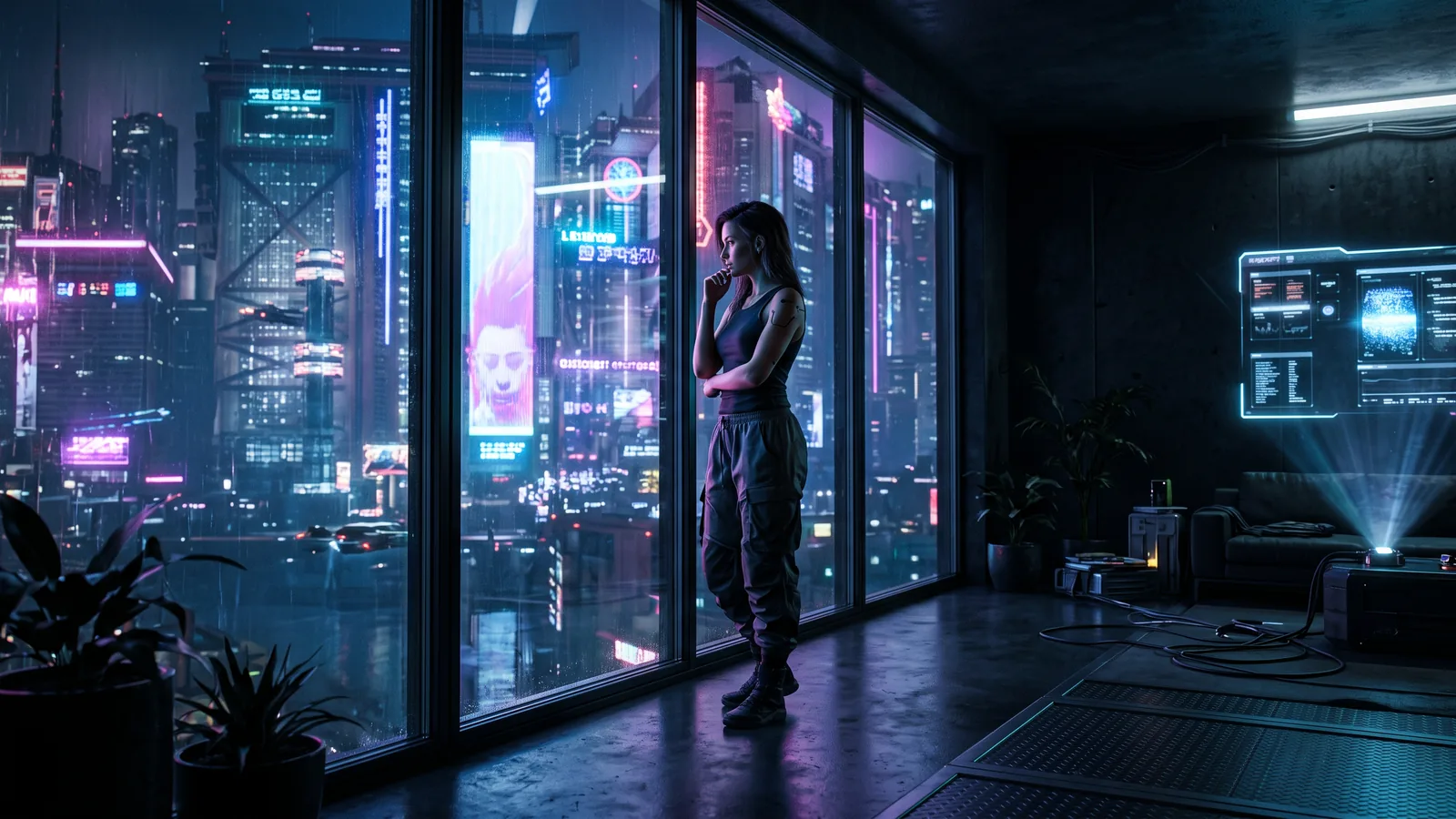
The topless figure in a sci-fi interior render carries different meaning than in a residential arch viz context. In speculative architecture — cyberpunk apartments, biopunk laboratories, orbital habitats, neon-lit near-future urban interiors — the unclothed body is often a deliberate statement about the relationship between human biology and synthetic environment.
The figure is not simply a lifestyle indicator. It is a contrast element. A topless female figure in a cold neon-lit space makes the organic quality of skin visible against an entirely artificial context. The figure becomes the warmest, most textured surface in the frame. In cyberpunk visual language, this contrast — biological against technological, warm against cold, natural against synthetic — is thematically central.
Lighting conditions unique to sci-fi interiors
Sci-fi interiors use lighting setups that are rarely encountered in residential arch viz. These setups have specific implications for a topless figure.
Neon and LED exterior wash. The exterior of a future city typically floods the interior through floor-to-ceiling glass with high-intensity colored light. Blue, violet, and cyan are common for night-time exterior ambients. This light wraps around the figure from one side, creating deep shadow areas on the interior side. The SSS parameters for the figure need to be tuned to respond to these cold color temperatures — the warm-orange SSS setup for a morning bedroom scene will produce incorrect skin color in blue neon light.
Holographic and display light. A common interior light source in sci-fi renders is the holographic display or screen array. These produce soft, low-intensity colored light that is usually a mix of blue-white and cyan, with periodic color shifts. A topless figure standing near a display array will be lit from an unusual angle — often slightly from below or from one side — and the light will change color if the display is animated. This is one of the few cases in arch viz where the figure is lit by a dynamic light source, which requires either baking multiple light states or committing to a single display frame.
Bioluminescent and practical embedded lighting. Some speculative interior designs incorporate lighting embedded in walls, floors, or furniture surfaces — glowing panels, edge-lit surfaces, fiber-optic floor inlays. These create an ambient that wraps the figure from multiple angles and fills shadow areas more than traditional room lighting. The figure in this environment reads differently than in a single-source setup: it is more evenly lit, with less dramatic falloff, which shifts the visual emphasis toward silhouette and surface detail rather than chiaroscuro.
The figure as design element in speculative architecture
In speculative interior design, the figure is often placed to interact directly with architectural elements in ways that do not occur in residential renders:
Body and technology interface. A topless figure standing at a wall-mounted terminal, interacting with a haptic surface, or observing a data display is making the human-machine interface explicit. The unclothed body in this context emphasizes the contrast between the organic and the digital. The figure’s skin, with its micro-topology and SSS, is as much a material specification as the brushed metal of the terminal housing.
Scale of speculative spaces. Sci-fi interiors often play with scale in ways that residential arch viz does not — cathedral-height ceilings in an urban apartment, compressed low-ceiling spaces in a spacecraft, vertically stacked environments. A figure in these spaces is essential for communicating the unusual scale relationships. A topless figure, being less visually complex than a clothed one, is easier to read at any scale — the eye finds it immediately.
Reflective environment. Speculative interiors frequently use polished, highly reflective floor and wall materials — brushed metal panels, mirror surfaces, wet-look epoxy floors. A topless figure in a reflective environment creates secondary views of the figure through reflections, which can be used compositionally to show multiple angles of the architecture simultaneously. The figure’s reflection on a polished floor, partially obscured by the camera angle, is a standard sci-fi render composition.
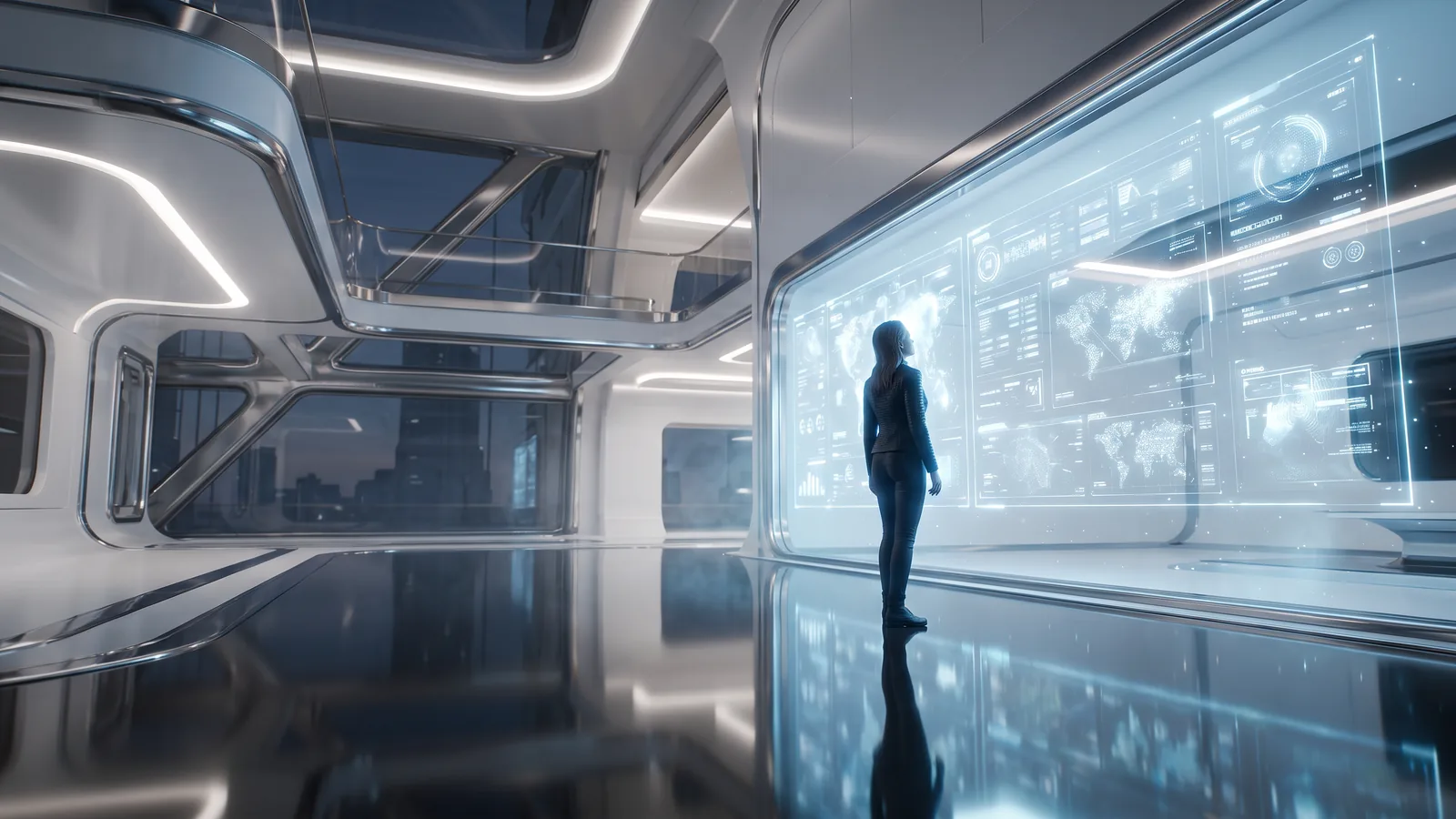
Technical requirements for sci-fi figure integration
The same photogrammetry-scanned figure used in a residential render can be used in a sci-fi interior, but the material setup requires specific adjustments:
SSS color temperature matching. The subsurface scattering color should shift toward the dominant ambient. In a blue neon environment, the SSS color should have a slight cool cast on the deep scatter channel. The surface scatter channel can remain neutral. This prevents the skin from appearing artificially warm against a cold environment.
Specularity in metallic environments. A polished-floor sci-fi interior will produce reflections of the figure on the floor surface. The reflection should be integrated into the render rather than composited in post. The figure’s material needs to be physically plausible — Fresnel behavior, correct roughness — so that the floor reflection looks like a physical reflection, not a projected image.
Skin in colored ambient. When the entire ambient is a single color (all-blue neon wash, all-green bioluminescent), the figure’s skin will pick up that color in the ambient-lit areas. This is correct physically but can produce jarring results visually. The conventional approach is to use a warm secondary fill from an interior practical light source (a lamp, a surface panel) to maintain some skin warmth in the fill areas, preserving the contrast between the warm-biological figure and the cold-synthetic environment.
Wardrobe adjacency. A topless figure in a sci-fi interior often appears in combination with a speculative garment — a visor, a tech accessory, a futuristic lower garment. The partial garment grounds the figure in the speculative world without requiring full costume design. It also makes the topless treatment read as a design choice within the fiction rather than simply an absence of clothing.
The Renderbot library includes scanned female figures in upright and active poses compatible with sci-fi interior placements and technology-interaction scenarios.
Comments
No comments yet.