


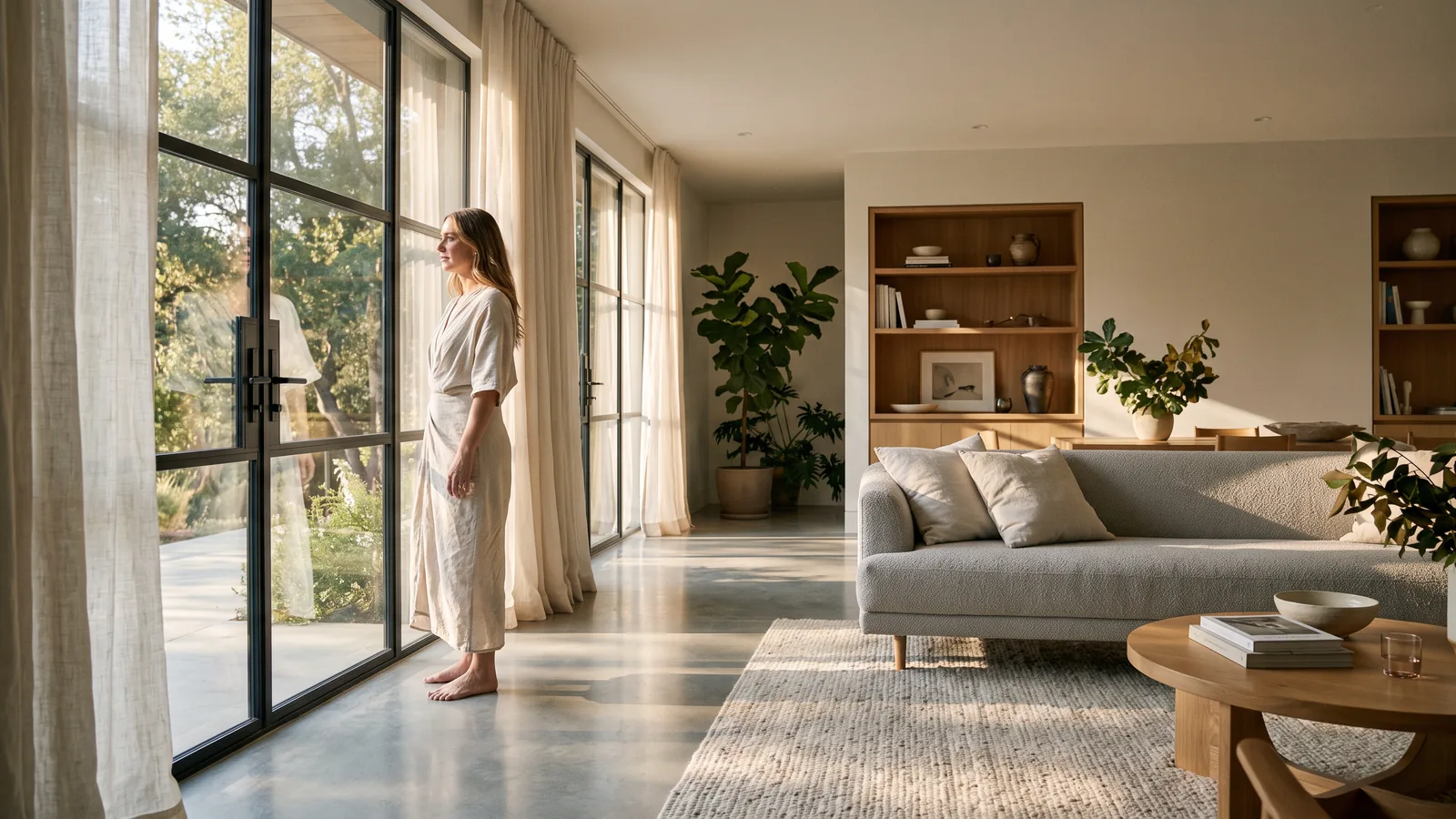
A figure in an interior render does one thing: it tells the viewer how the space is experienced. An empty room shows geometry and materials. A room with a figure shows those same things, plus scale, light quality, and what it feels like to be inside. The choice of a topless female figure in a residential interior render is a specific creative decision — one that places the scene in a private, domestic register.
This is a standard category in high-end residential arch viz. It appears in presentations for apartments, houses, master suites, and lifestyle-focused interior design projects. The figure signals that the render is not a showroom catalog shot but a representation of lived experience. The topless treatment communicates that the moment is private — early morning, after a bath, a quiet weekend — and that the occupant is fully at home in the space.
When a topless figure is the right choice
Not every interior render benefits from a figure. And not every figure needs to be topless. The topless treatment is appropriate in a specific set of scenarios:
Private zones of the home. Master bedrooms, bathrooms, dressing areas, and private terraces are the natural context. These are rooms where the occupant’s relationship to the space is intimate. A figure dressed for the office would be incongruous; a figure in a robe or nothing at all communicates the actual quality of the space.
Morning and evening light scenes. The two lighting conditions that most benefit from a topless figure are morning daylight (soft, directional, coming through glass) and evening lamp light (warm, contained, creating deep shadow areas). Both are lighting conditions that imply private time. The figure reinforces the temporal quality of the light.
Lifestyle and editorial presentations. When the render is intended for a magazine, a developer’s marketing material, or a lifestyle brand collaboration, the figure lifts the image out of the technical documentation register and into editorial photography. This is where a topless figure earns its place most clearly — it matches the visual language of shelter media and lifestyle publishing.
When the material is the story. A topless figure draws attention to the skin, which is itself a highly detailed surface that responds to light. In a render that is partly about demonstrating material quality — polished concrete, linen upholstery, warm timber — the figure’s skin becomes another surface in the composition, one the viewer knows intuitively how to read.
Technical requirements for the figure
A hand-modeled figure in a topless interior render will read as a mannequin. The skin will be too smooth, the proportions slightly wrong, and the response to light unconvincing. The figure will look placed, not present.
A photogrammetry-scanned figure solves this. Photogrammetry captures real skin’s micro-topology — pore structure, surface variation, the slight asymmetries of a real body — and embeds them in the mesh. The result is a figure that responds to light the way real skin does: subsurface scattering at the lit side, retained surface detail in shadow areas, correct specular behavior at grazing angles.
The key technical parameters for a topless figure in an interior render:
Subsurface scattering radius. For chest and upper arm skin, the SSS radius should be calibrated to the light color and intensity. Warm lamp light requires a slightly orange-tinted SSS; cool daylight from a window requires a neutral-to-cool SSS. Getting this wrong produces skin that reads as either wax or rubber.
Normal map detail. A photogrammetry-scanned figure will have a normal map that includes skin micro-topology. At the render resolutions used in arch viz (typically 4K to 8K), this detail is visible in close-proximity views. It is what separates a render that reads as photographic from one that reads as 3D.
Pose naturalness. A standing or seated topless figure needs to be in a pose that communicates comfort and ease. Stiff, symmetrical poses read as posed for a photograph, which breaks the domestic-intimacy register. The figure should have a slight weight shift, natural arm position, and a head orientation that is engaged with the space rather than presenting to the camera.

Composition principles
The topless figure in an interior render should read as part of the architecture, not as the subject of the image. These composition principles help:
Orient the figure toward the architecture. A figure looking toward a window, a view, or a fireplace makes the architecture the destination. A figure looking toward the camera makes the figure the destination. In an arch viz context, the architecture should always be what the composition leads toward.
Use the figure to establish scale. The standard ceiling-to-figure-top proportion is what tells the viewer how large the room is. A topless figure standing near a full-height window is simultaneously showing: skin, light quality, ceiling height, floor material, the character of the glass and frame, and the view. All of this for one compositional element.
Let the light describe the figure. The figure should be lit by the scene’s existing light sources — the window, the lamp, the ambient — not by any supplementary light added specifically for the figure. A figure with its own light source looks lit for a photograph. A figure lit by the room’s light looks like it belongs in the room.
Keep clothing minimal. A topless figure that retains a draped fabric at the lower half — a sheet, a towel, a loose garment — is easier to integrate into most room contexts than a fully nude figure. The fabric provides a visual transition between the figure and the furniture or floor, and grounds the figure spatially.
Post-processing
Interior renders with topless figures often require specific post-processing decisions:
The figure’s skin tone should be color-graded together with the other warm-toned surfaces in the room (timber, fabric, warm-tinted materials). A figure whose skin sits outside the room’s color temperature will read as composited in, not rendered in.
Depth of field, when used, should treat the figure the same as any other object at the same depth. A sharp figure in a soft room, or a soft figure in a sharp room, reads as a composite.
The Renderbot library includes photogrammetry-scanned female figures in a range of standing and seated poses suitable for interior arch viz presentations, including topless and nude options.
Comments
No comments yet.