


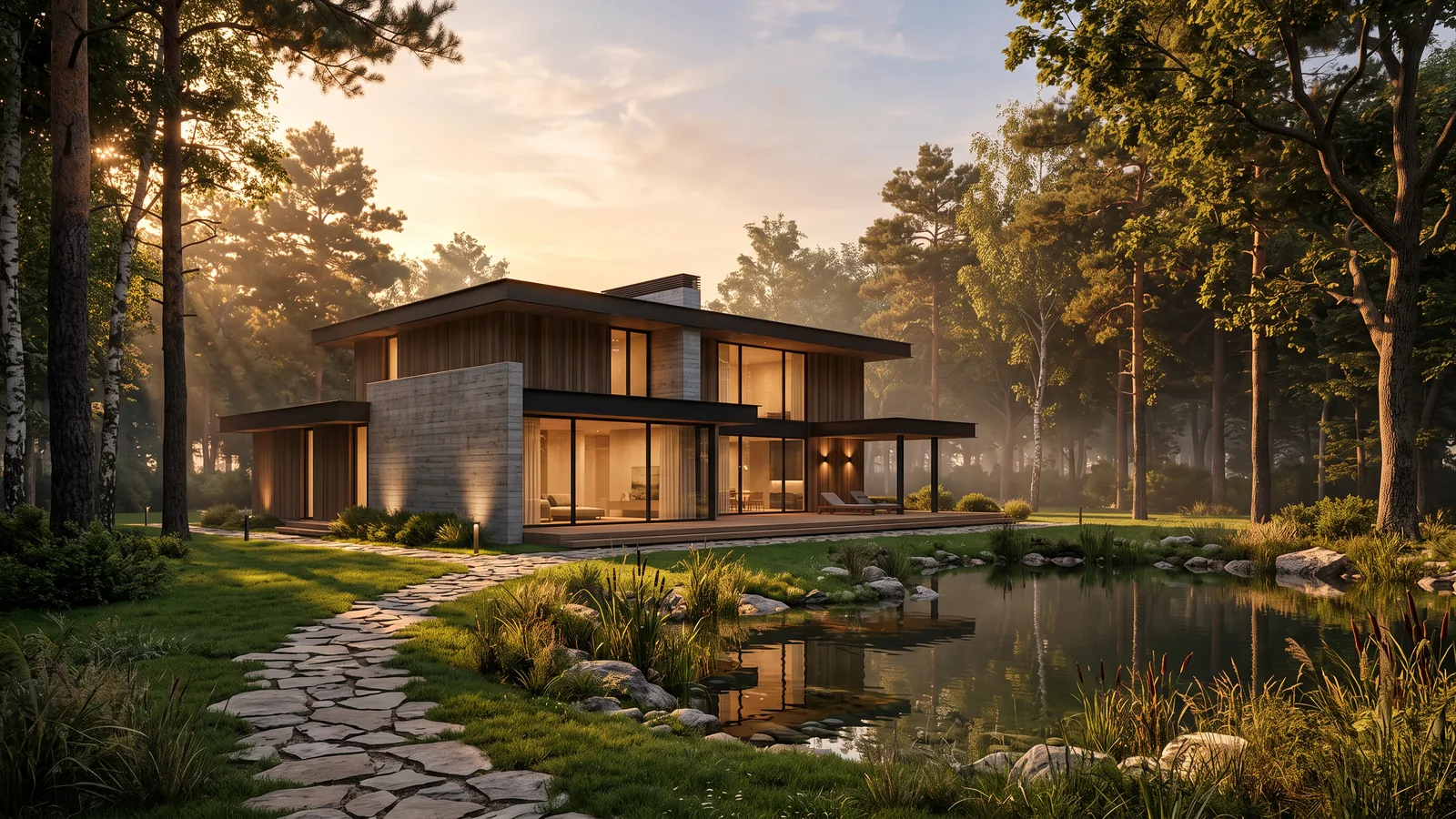
There is a paradox at the center of exterior arch viz. The building — the client’s primary investment, the deliverable the whole project is organized around — is often the least difficult element to render convincingly. It is the nature around it that breaks renders.
A flat or artificial-looking sky. Trees with the wrong silhouette. Grass that tiles visibly. Water that reflects the wrong color at the wrong angle. These are the problems that experienced arch viz artists spend most of their time on.
Why nature is harder than architecture
Architecture is deterministic. A wall is a flat surface with a material applied. Its behavior under light is predictable and can be approximated well with standard PBR workflows.
Nature is not deterministic. A tree has millions of leaves, each of which catches light differently depending on its angle, age, and position within the canopy. Grass bends under its own weight and in response to wind. Water has surface tension, internal refraction, and a surface texture that changes at different scales.
Rendering nature accurately requires either very high polygon counts or very good approximations. Both are technically demanding, and the difference between a good approximation and a bad one is immediately visible to any viewer who has seen trees.
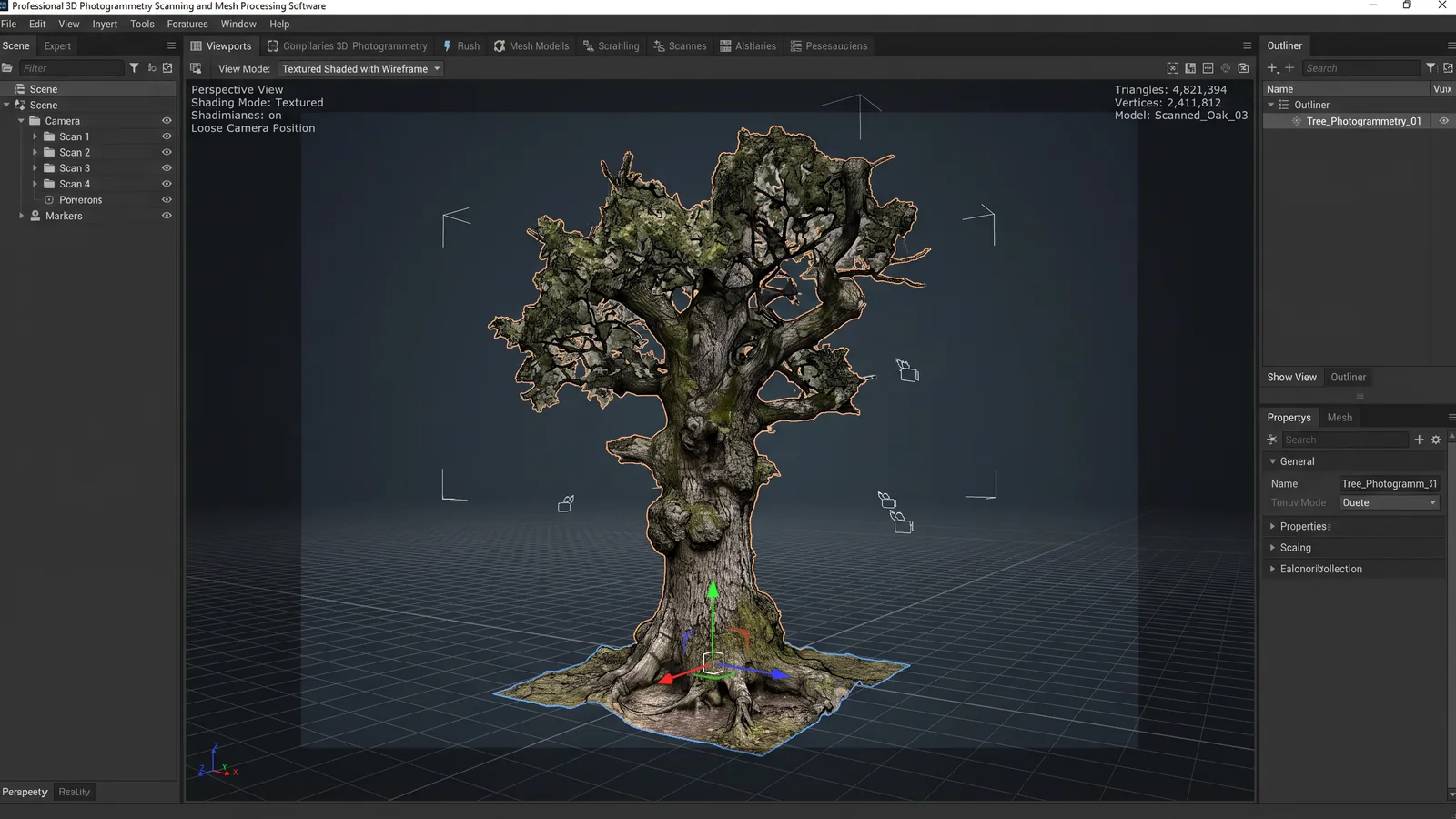
Trees: what actually matters
Trees are the highest-impact nature asset in exterior renders. They appear at a range of distances — from 50 meters in the background to 3 meters in the foreground — and need to read convincingly at all of them.
Silhouette density. The outline of a tree against sky is the first thing a viewer registers. Sparse or geometrically regular silhouettes read as fake immediately. Good tree models have enough leaf density and irregularity to produce a natural silhouette.
Level of detail. A tree model that works at 50 meters will have far too many polygons for a scene that includes 20 trees. The model needs either a built-in LOD system or a low-poly proxy for distant placement.
Wind animation. Still exterior renders do not require animation, but walkthroughs and videos do. Tree models that include pre-built wind animation rigs save significant time.
Species accuracy. A render of a building in central London with Mediterranean cypress trees is wrong. Clients who know their region will notice. The tree species in a render should match the planting zone of the project location.
Bark and substrate texture. The base of a tree where it meets ground reads differently from the canopy. Bark texture resolution matters most in the foreground, where camera proximity reveals surface detail.
Grass, groundcover, and terrain
Ground surface is often treated as a background element, but it occupies a significant portion of exterior renders.
Grass shaders vs geometry. Grass is almost never modeled as individual blades at render time. It is approximated using either a dense particle system of flat cards or a displacement-driven shader. The card system is more flexible for distance variation. The shader is faster to render.
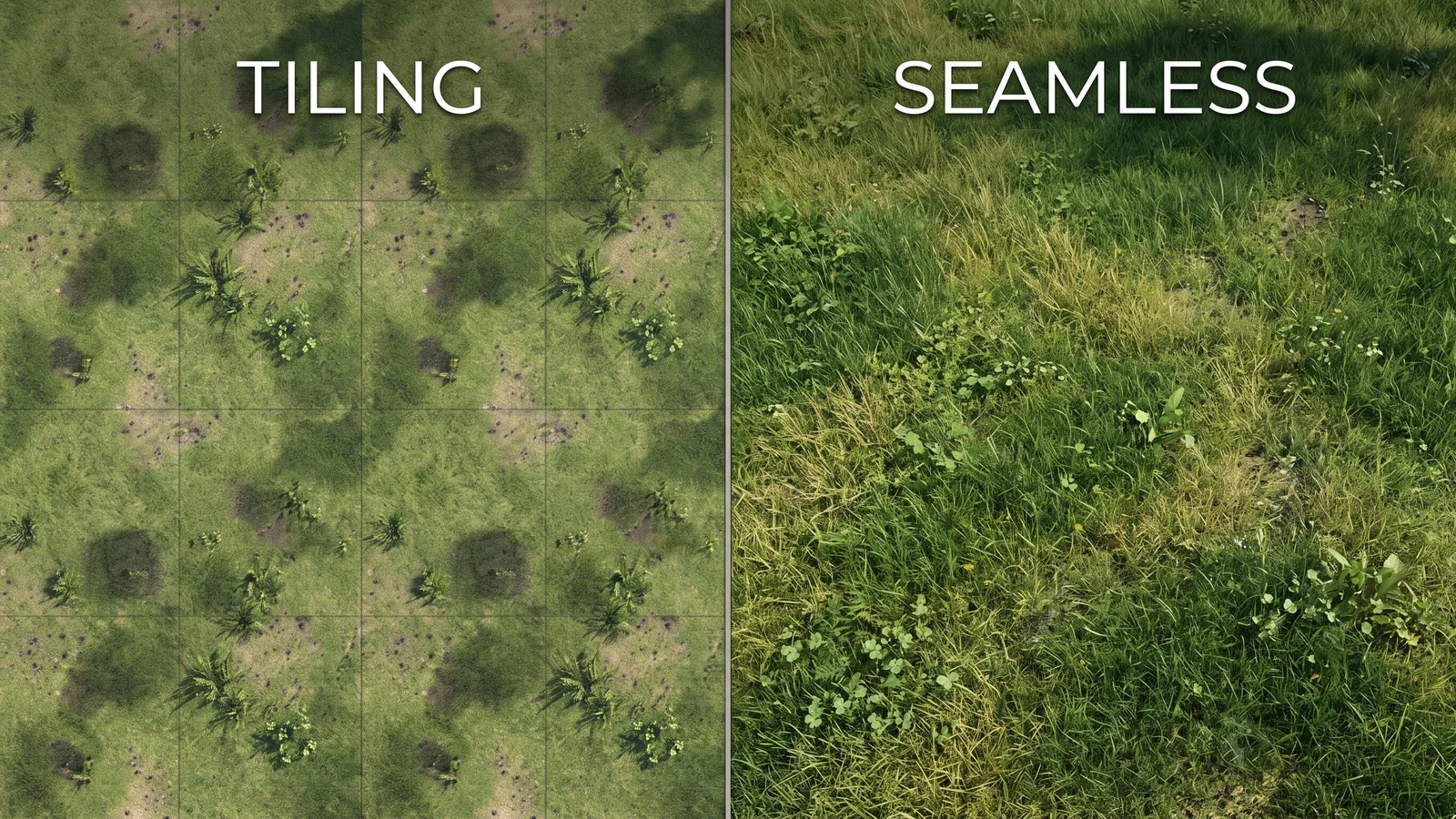
Tiling artifacts. The most common failure in ground surface rendering is visible tiling. A grass texture that repeats on a 2-meter grid is immediately legible as synthetic. Proper ground materials use multiple overlapping texture layers at different scales to break the regularity.
Wet and dry states. Ground surface changes character dramatically with moisture. A render of a building in a wet climate with bone-dry soil reads as inconsistent. The soil material should match the season and climate implied by the scene.
Water features
Water appears in exterior renders as pools, ponds, streams, rain-wet surfaces, and reflected sky. Each context has different rendering requirements.
Pool water. Primarily a reflective and refractive surface. The geometry is simple. The complexity is in the material: caustics, subsurface color, surface ripple, and the transition zone at the pool edge.
Natural water. Rivers, lakes, and ponds require more complex surface geometry to represent natural movement. Static renders can use a displaced surface. Animation requires fluid simulation or a looping texture.
Wet pavement. One of the most effective techniques in exterior renders is wet pavement after rain. Reflective ground surfaces dramatically improve light distribution in a scene and add atmospheric depth. The material is straightforward — a reflective layer over the base pavement — but the effect is significant.
Rocks and hardscape
Rock surfaces appear as garden features, retaining walls, and terrain in exterior renders.
Photogrammetry-scanned rock geometry captures surface irregularity that hand-modeled rocks consistently fail to replicate. The micro-surface variation of real stone, particularly sedimentary and weathered rock, produces lighting responses that approximated geometry cannot match.
For paving and hardscape, the material quality depends on the mortar joint geometry and the surface aging. New paving reads as artificial. Renders with appropriate surface variation and weathering age the material convincingly.
Seasonal and climate consistency
The collection of nature assets in a scene must be internally consistent. A scene set in summer should have:
– Full-canopy trees with green leaves – Dry or moderate soil – Warm-toned directional light – Long shadows at the render hour implied by the sun position
A scene set in winter should have: – Bare or snow-covered branches – Cold-toned ambient light – Blue-tinted shadows – Snow accumulation that respects gravity (more on horizontal surfaces than vertical ones)
Mixing seasons — winter light with full-summer trees, summer soil with late-afternoon autumn light — is one of the most common coherence failures in exterior renders.
Performance in complex scenes
A landscape scene with 50 trees, grass coverage, and water features will have a very high polygon count and render time. Managing performance requires:
Instancing. Repeating the same tree model multiple times as instances rather than unique meshes reduces memory and render time significantly. Most rendering engines support instancing natively.
Render layers. Separating the nature elements into their own render layer allows them to be rendered at different quality settings or composited in post, reducing total render time.
Proxy geometry. For background trees beyond 30-40 meters, a low-polygon proxy with the correct silhouette is indistinguishable from a full-resolution model and renders an order of magnitude faster.
The Renderbot nature library includes scanned trees, rocks, and terrain assets in formats compatible with V-Ray, Corona, Enscape, and Lumion.
Comments
No comments yet.