



Gaussian Splatting appeared in a research paper in 2023 and went from academic novelty to production consideration remarkably fast. By 2026, it is a workflow that professionals need to understand even if they are not using it yet.
The basic idea
Traditional photogrammetry and NeRF (Neural Radiance Fields) represent 3D scenes in ways that need to be converted into images at render time. Gaussian Splatting takes a different approach.
A Gaussian Splat represents a scene as a collection of 3D Gaussian distributions — think of each one as a small, semi-transparent, colored ellipsoid in 3D space. A typical scene contains 1-10 million of these splats. When rendered from any viewpoint, the splats are sorted by depth and “splatted” onto the image plane — each one contributing its color and opacity.
The critical property: this process is very fast. A Gaussian Splat scene can render at real-time framerates on consumer GPUs without approximations.
How a Gaussian Splat is created
You start with a set of photographs of a scene, taken from many angles — exactly like photogrammetry. The optimization process adjusts millions of Gaussian parameters (position, size, orientation, color, opacity) until the rendered output from each known camera angle matches the corresponding photograph. The result is not a mesh — there are no polygons, no textures in the traditional sense.
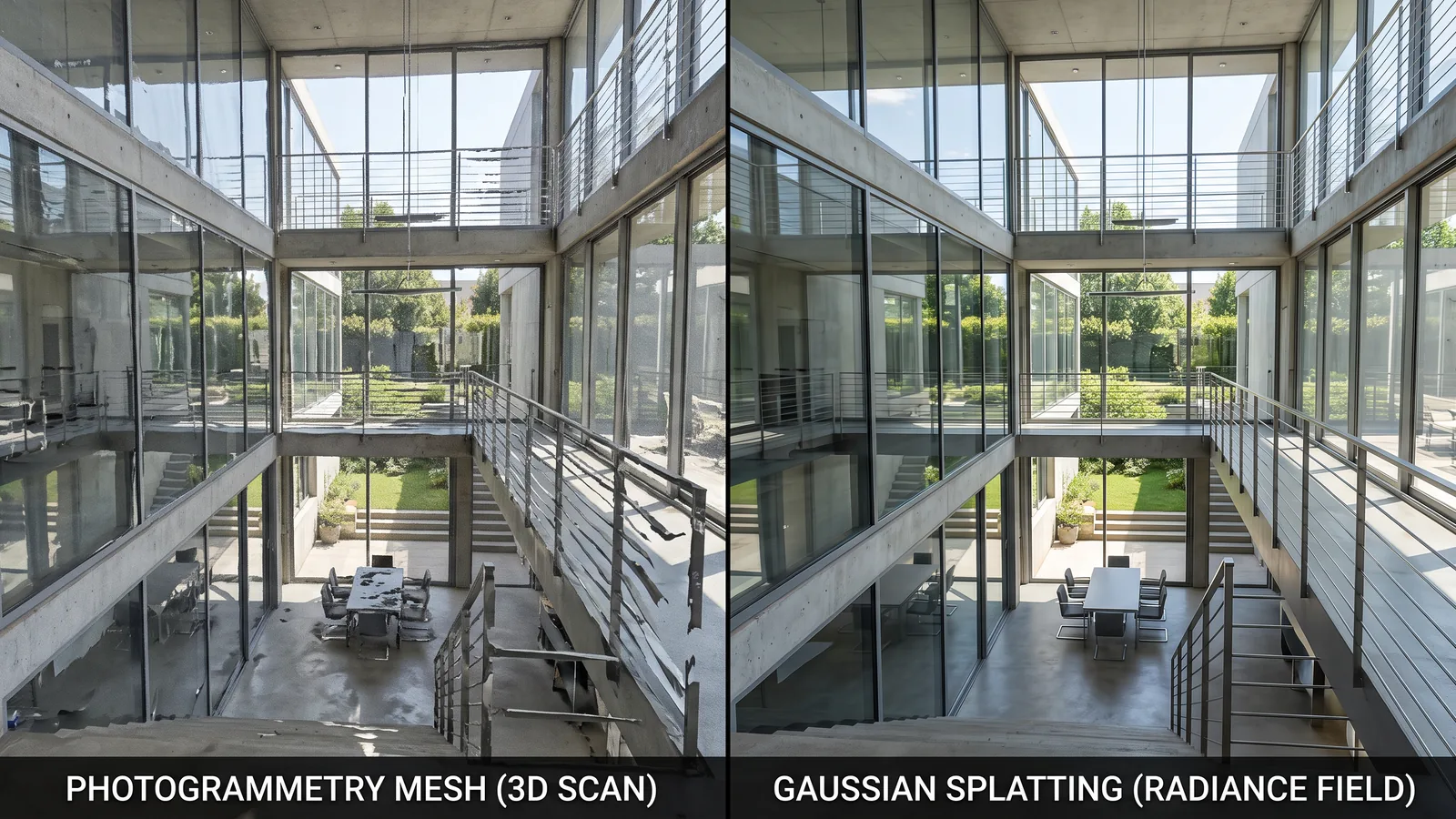
What Gaussian Splatting cannot do
- Export to standard 3D formats (FBX, OBJ, USD) — there is no mesh
- Modification — the scene is fixed at the time of capture
- Integration with standard rendering pipelines
- Accurate geometry for technical use
Where Gaussian Splatting fits right now
Virtual site visits, reference and research, and interactive client presentations. It is not replacing photogrammetry for asset production, and it is not replacing mesh-based workflows for editable 3D content.
For production-ready mesh-based human assets, the RenderBOT library provides photogrammetry-scanned figures in formats ready for any pipeline.
Comments
No comments yet.