


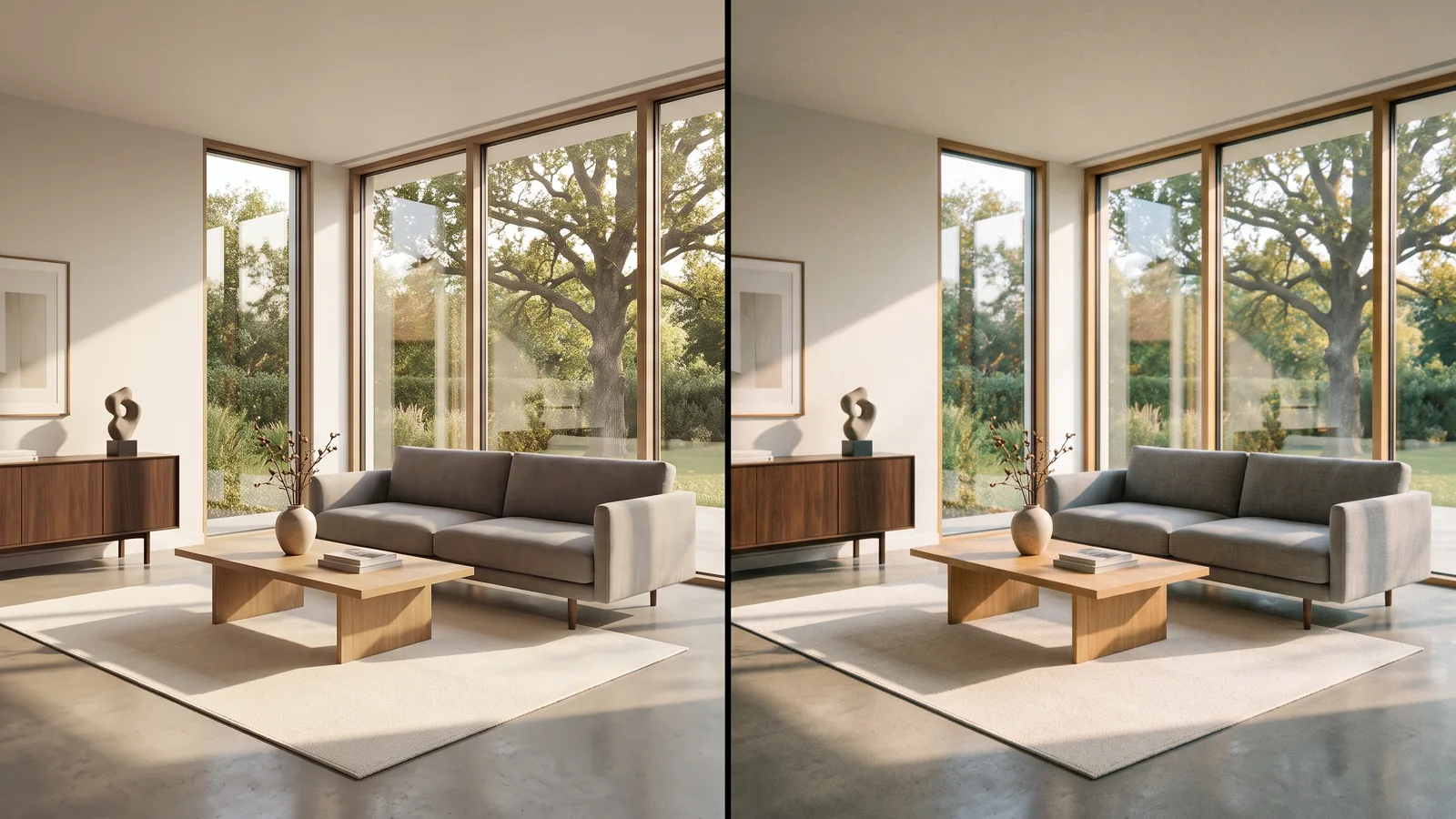
Photorealistic appears in roughly one third of all 3D render portfolios and product descriptions. It is used to describe outputs that range from barely adequate to genuinely indistinguishable from photographs. The word has been inflated past usefulness. But the underlying concept still matters.
What the word originally meant
Photorealism in CGI was originally a technical claim: an image produced by a computer that could pass for a photograph. Early photorealistic renders were compared against still-life photography: controlled lighting, simple surfaces, no people. That standard has been obsolete for years.
What photorealism requires now
Lighting coherence. Every light source has a physically consistent falloff, shadow softness, and color temperature. Bounce light behaves correctly. No invisible fill lights, no magic ambient that removes shadow from corners.
Material accuracy. The micro-surface variation that makes a painted wall look like paint rather than colored plastic. The way cotton absorbs light differently than polyester. The subsurface effect in translucent materials like marble or skin.
Geometry density and detail. Real objects have edge imperfections. A perfectly beveled architectural edge does not exist in the physical world. Renders without these imperfections read as computer-generated even when every other parameter is correct.
Scale-appropriate detail. A human figure at 10 meters does not need pore-level skin detail. It does need correct silhouette and proportions. A counter at 1 meter does need surface texture.
The human figure problem
The place where most renders fail the photorealism test is not the lighting or the materials — it is the people. Lighting and materials have been a solved problem for most render engines for several years. The gap between a CGI human figure and a real person is not negligible. The uncanny valley is real, and the slightest incorrectness in skin or proportion registers as wrongness even when the viewer cannot articulate it.
This is why photogrammetry-scanned human figures — which capture rather than approximate skin detail — have become a significant differentiator. See our detailed comparisons: why photogrammetry beats hand-modeled humans and MetaHuman vs scanned models.
A better vocabulary
Photorealistic: indistinguishable from a photograph of the same scene under the same conditions. High fidelity: extremely detailed and accurate, falls short of full photorealism on inspection. Stylized realism: accurate materials and lighting with intentional departures. Schematic: representing the design accurately without claiming photographic quality.
Most renders described as photorealistic are actually high fidelity. That is not a lesser achievement — it is a different goal. For more on improving scene believability, see 5 arch viz mistakes that make renders look fake. For the human figures specifically, browse the people category in our store — interior, exterior, business.
Comments
No comments yet.