


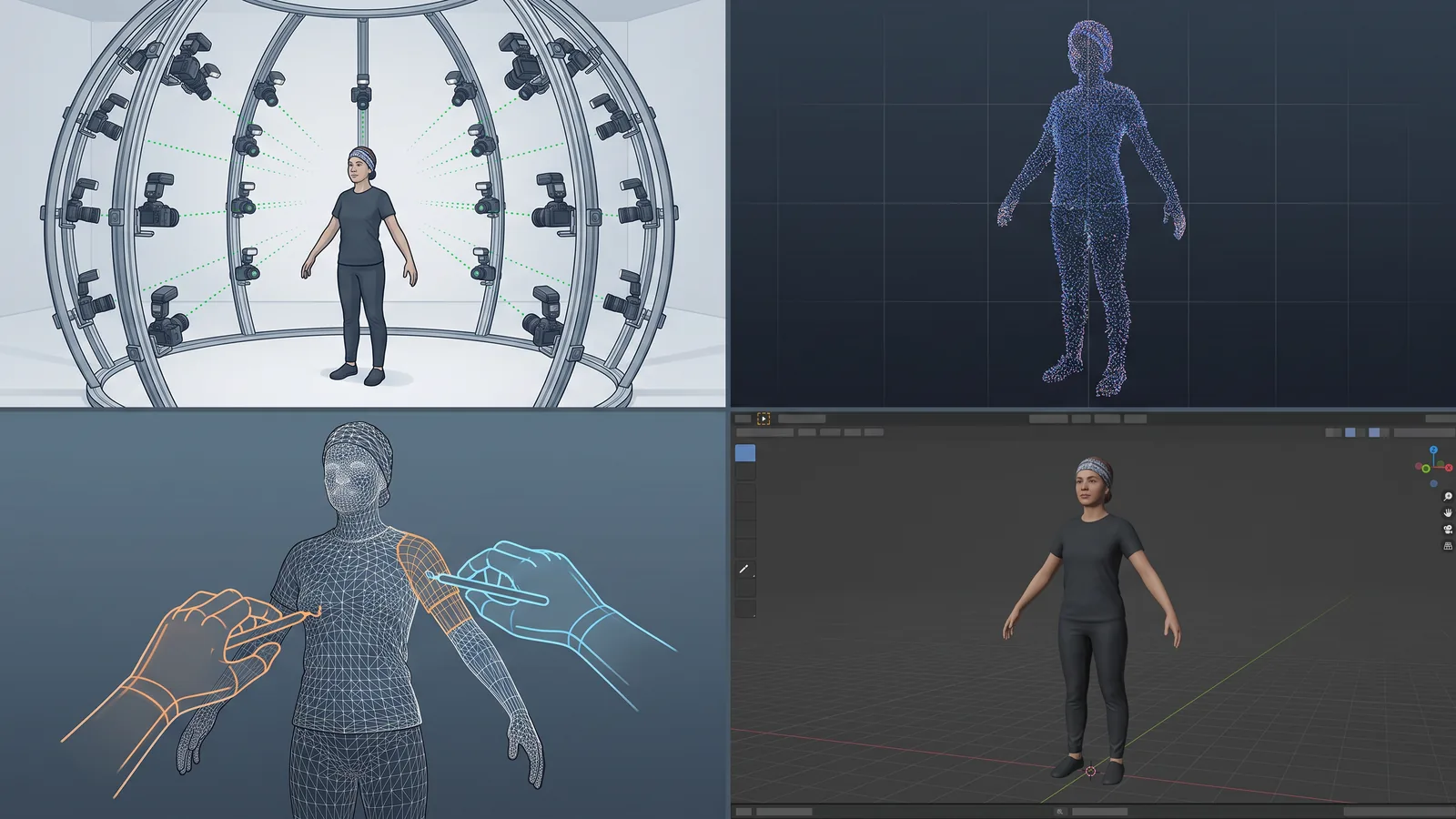
People who use scanned 3D models often do not know what went into making them. That is by design — the goal is a clean asset you can drop into a scene without thinking about its origin. But understanding the pipeline clarifies why high-quality scans cost what they cost, what distinguishes good assets from mediocre ones, and what to look for when evaluating a library.
Stage 1: Capture
A professional photogrammetry rig for human scanning uses between 100 and 400 cameras arranged in a dome or ring around the subject. All cameras fire at exactly the same millisecond — controlled by a hardware sync signal, not software, because even a few milliseconds of motion between exposures produces reconstruction artifacts.
The subject stands still for approximately one second while the rig fires. That single firing event is the entire capture. A session with a human subject might take 30 minutes including setup, wardrobe, and 3–5 takes for different poses.
Stage 2: Reconstruction
The raw photographs go into photogrammetry software — most professionally used is Agisoft Metashape or RealityCapture. The software identifies matching features across all images, reconstructs the position of every camera in 3D space, generates a dense point cloud, and converts it to a polygon mesh.
This step takes hours on a high-end workstation. The raw mesh coming out is not usable: it has holes, noise, and far too many polygons (often 20–50 million).
Stage 3: Cleanup and retopology
This is where human time goes. Artists fill holes (anywhere cameras could not see — armpits, under the chin, between fingers), remove noise, and retopologize the mesh. The raw polygon distribution is chaotic; retopology creates a clean quad mesh with edge loops that follow the body’s natural forms, enabling animation and clean deformation.
For a full human body, retopology alone can take 4–8 hours for an experienced artist. The difference between a cheap scan and a production-ready one is often this stage.
Stage 4: Texture baking and optimization
The cleaned mesh gets new UV maps. The original high-resolution photographic textures are baked down to these UV maps — typically at 8K or 16K resolution for the full body, with separate maps for albedo, normal, roughness, and sometimes specular. A final quality pass checks the asset in multiple render engines (Blender, Unreal, V-Ray) under different lighting conditions.
What all this means when you are buying assets
A cheap scan likely skipped or compressed the retopology and cleanup stages. The mesh may have holes, noise, or animation problems you will only discover when you try to use it. When evaluating a library, look for: edge loop topology visible in wireframe previews, clean results at LOD1 and below, multiple engine formats actually tested, and face detail that holds at close range.
The models in our library go through the full pipeline — capture, reconstruction, cleanup, retopology, and engine testing. The download is the end of a process that starts 4–6 weeks earlier. Browse by category: people, animals, or anatomy. Also read our article on why photogrammetry beats hand-modeled humans for a comparison of the two approaches in production.
Comments
No comments yet.